When mornings are short and calendars are packed, deciding what to wear can steal more focus than any meeting. Workwear planning for busy professionals isn’t about buying more clothes; it’s about building a flexible system that turns your closet into a reliable workflow. With a clear capsule, a repeatable weekly routine, and a few smart tools, you can reduce decision fatigue, project a consistent personal brand, and look polished no matter what your day throws at you.
Define Your Work Dress Code and Personal Brand
Before you plan, clarify expectations and your own style goals. Start with two questions: What’s the real dress code in your environment (from fully formal to startup casual)? And what three words describe how you want to be perceived (e.g., credible, modern, approachable)? Use these answers to filter every decision. If a piece doesn’t fit the dress code or your brand words, it doesn’t belong in your weekday rotation.
- Dress code spectrum: Formal, business professional, business casual, smart casual, casual.
- Brand words examples: Minimal, creative, classic, athletic, refined, bold.
- Color palette rule: 2 base neutrals, 1 supporting neutral, 1–2 accents that flatter your complexion.
Build a Workwear Capsule That Works
A work capsule is a tightly edited set of pieces that mix and match across the week. The goal is high compatibility and low maintenance. Focus on breathable fabrics, crease resistance, and silhouettes that layer easily. Start with a 20–25 piece capsule covering a five-day workweek plus variations for travel, presentations, and after-hours events.
| Category | Quantity | Examples | Notes |
|---|---|---|---|
| Tops | 5–7 | Oxford shirts, silk blouses, merino tees | Wrinkle-resistant, breathable, machine-washable if possible |
| Bottoms | 4–5 | Tapered trousers, wide-leg pants, pencil or A-line skirt | Two fits in your base neutral, one seasonal texture |
| Dresses/Jumpsuits | 2–3 | Sheath dress, shirt dress, tailored jumpsuit | Great for one-and-done days and travel |
| Layers | 3–4 | Blazer, lightweight cardigan, structured knit jacket | One dark, one light, one textured |
| Shoes | 3–4 | Loafers, ankle boots, low block heels, clean sneakers (if allowed) | Prioritize comfort, quiet soles, and weatherproofing |
| Bags | 2–3 | Structured tote, slim backpack, crossbody | Fits laptop, looks professional, secure closures |
| Accessories | 5–7 | Belts, watches, minimal jewelry, silk scarf | Elevate basics; keep a cohesive metal tone |
| Outerwear | 1–2 | Trench, wool coat | Neutral color, easy over blazers |
| Seasonal | 2–3 | Linen blazer, cashmere knit, thermal layers | Swap quarterly to keep the capsule lean |
Stick to fabrics that behave well: performance wool blends, Tencel, heavier-weight jersey, stretch cotton, and technical knits. Avoid pieces that require daily steaming unless you love that ritual. With a capsule tuned to your climate and commute, you’ll spend less time matching and more time moving.
A Weekly Workwear Planning Workflow
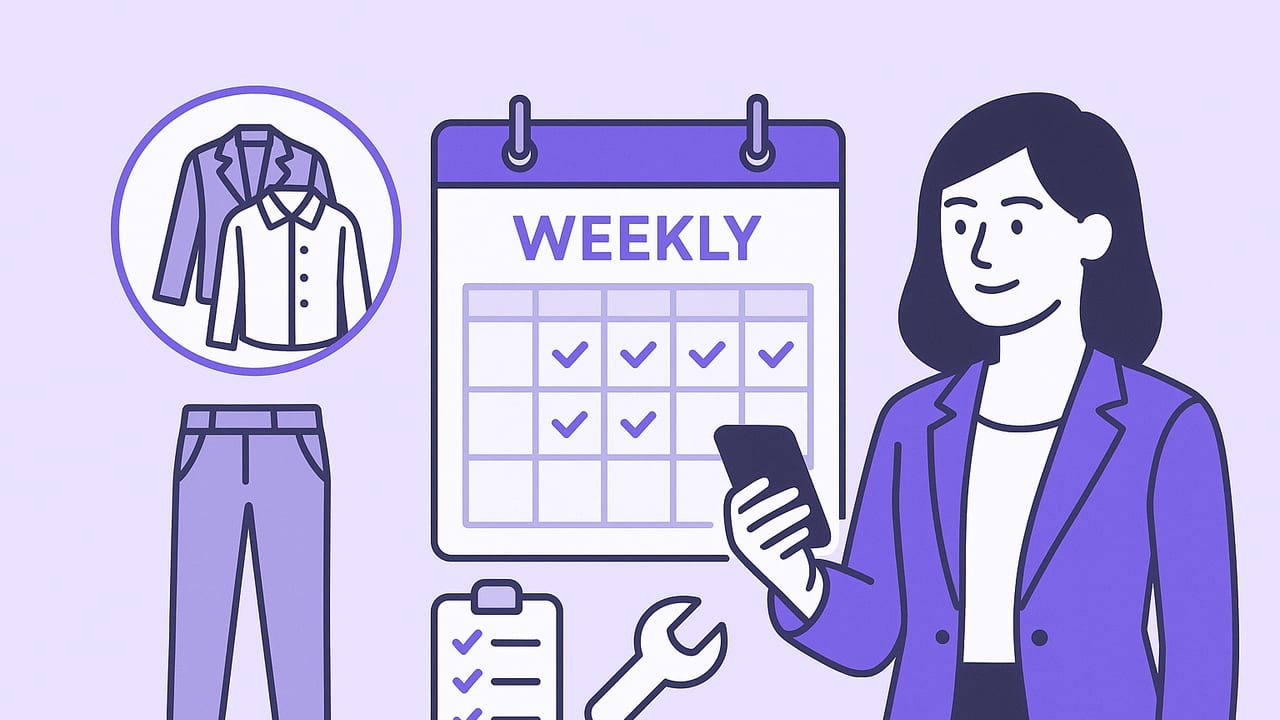
Workwear planning for busy professionals succeeds when it runs on a reliable routine. Try this 20-minute Sunday reset to prepare five ready-to-wear looks:
- Scan your calendar: Flag presentation days, client meetings, on-site visits, and long commutes.
- Check the forecast: Note temperature swings, rain, and wind; pre-plan outerwear and shoes.
- Choose five outfit formulas: Assign one to each day based on formality and weather.
- Pre-stage outfits: Hang each look together with its belt, scarf, and jewelry in a labeled section.
- Prep maintenance: Steam, lint-roll, polish shoes, and refill your on-the-go kit (lint roller, blotting papers, stain pen).
| Day | Forecast/Events | Outfit Formula | Notes |
|---|---|---|---|
| Mon | Rain + team sync | Blazer + knit tee + tapered trousers + loafers | Waterproof tote, umbrella |
| Tue | Client pitch | Suit set + silk shell + low heels | Keep neutral jewelry; bring backup flats |
| Wed | Heads-down | Shirt dress + belt + boots | Add cardigan for AC |
| Thu | Warm + commute | Breathable blouse + wide-legs + sneakers (if allowed) | Structured crossbody |
| Fri | Smart casual | Fine-gauge knit + pleated pants + loafers | Swap scarf for after-work dinner |
Pre-staging five looks reduces morning friction and prevents outfit repeats in the same week. Keep a notes app or wardrobe log to record what worked, what wrinkled, and what needs tailoring.
Outfit Formulas for Common Workdays
Formulas are repeatable combinations that fit your dress code. Build a small library, then rotate.
- Presentation day: Matching blazer + trouser suit, silky shell, low block heel, minimal jewelry.
- Client lunch: Soft-shoulder blazer, blouse, midi skirt, ankle boot; add a subtle scarf for color.
- Desk-heavy day: Knit blazer, merino tee, drawstring tailored trousers, sleek sneakers (if policy allows).
- Hot commute: Short-sleeve blouse, wide-leg lightweight pants, leather flats; hair tie and anti-humidity spray.
- Cold snap: Merino turtleneck, lined trousers, blazer, wool coat, leather gloves; rubberized soles.
Create a quick-reference matrix: list tops across, bottoms down, and highlight combinations that are both comfortable and policy-safe. Aim for a 70% hit rate where any top works with any bottom; that’s the hallmark of a strong capsule.
Speed Tactics: Save Time, Look Polished
- Pre-pack kits: Keep a zip pouch in your work bag with stain remover, spare hosiery/socks, mini lint roller, mints, and travel steamer at the office if possible.
- Two fits, same fabric: Buy your favorite trouser in two silhouettes (tapered and wide-leg) and the same neutral; mix-and-match without color drift.
- Quiet footwear: Rubber taps or rubber-soled loafers reduce noise and add grip for fast commutes.
- Use a valet hook: Install a hook by your closet door just for next-day outfits.
- Color discipline: Keep metals consistent (all gold or all silver) for automatic coordination.
- Duplication strategy: Own two of your most-worn base layers (e.g., black merino tee) to cut laundry bottlenecks.
Professional style is a system, not a single outfit. Build the system, and the clothes take care of themselves.
Travel-Ready Workwear Planning
Frequent business travel adds constraints—wrinkles, weight limits, and variable dress codes. Use a 3–2–1 packing formula for a two- to three-day trip:
- 3 tops (wrinkle-resistant, one dressier)
- 2 bottoms (one darker for versatility)
- 1 layer (unstructured blazer or knit jacket)
- 1 one-and-done (dress or jumpsuit)
- 2 shoes (day pair + dressier pair)
Roll knits, fold tailored items with tissue paper, and unpack upon arrival. Keep a travel set of toiletries and a compact steamer to reduce morning surprises. Photograph successful trip looks to reuse on your next itinerary.
Fit, Size, and Climate Considerations
No planning system works if fit is off. Prioritize tailoring for trousers and sleeve lengths; a 20-minute alteration can rescue a piece you’ll wear weekly. For heat, choose airy weaves (open-knit merino, Tencel, linen blends) and looser silhouettes with structure from a belt or collar. For cold, layer thin, warm fabrics (silk or merino base, then blouse, then blazer) to maintain polish without bulk. If your workplace spans sizes or accessibility needs, look for adaptive closures, elasticized waistbands with clean fronts, and stretch-lined blazers that move with you.
Care, Rotation, and Budget
Plan a rotation that extends garment life:
- Laundry cadence: Air knits between wears; dry-clean suits as needed, not weekly. Use a home steamer for freshness.
- Shoe rest: Alternate days; add cedar shoe trees to preserve shape.
- End-of-week reset: Mend loose buttons, spot clean, and set aside anything that needs repairs.
- Budget allocation: Invest in workhorses (blazer, trousers, shoes); spend less on trend accents you’ll wear less frequently.
Track cost-per-wear to guide future purchases. A $200 blazer worn 80 times beats a $60 trendy piece worn twice. The capsule mindset frees budget for quality where it counts.
Digital Wardrobe Tools to Simplify Planning
Visualizing outfits accelerates decision-making. Photograph your clothes on a neutral background and tag them by category, color, season, and dress code. Use a digital wardrobe app to:
- Build outfit templates and save your favorites for repeating weeks.
- Drag-and-drop looks onto a calendar synced with weather and key events.
- Track wear frequency to spot true MVPs and underused items.
- Experiment with color and silhouette combinations without trying everything on.
If you prefer AI assistance, an iOS app like Outfit Maker can generate outfit combinations from photos of your own clothes and let you virtually try on options, then plan and compare looks side by side for the week.
Checklist: Your Next 7 Days
- Define this week’s key events and dress code moments.
- Check the five-day forecast; map outerwear and shoes accordingly.
- Select five outfit formulas; assign one per day.
- Pre-stage looks on hangers with accessories and underlayers.
- Prep care: steam, polish, lint-roll; stock your on-the-go kit.
- Photograph final outfits to log what works.
- Note any gaps (e.g., rain-proof shoes) for a future, intentional purchase.
Putting It All Together
Workwear planning for busy professionals is less about fashion and more about flow. A capsule reduces choice overload, a weekly calendar anticipates real-life constraints, and a small set of formulas keeps you consistent without being repetitive. Invest in quality for the pieces you rely on, maintain them well, and use digital tools to visualize, log, and iterate. With this system, your morning outfit becomes the easiest decision of the day—freeing up energy for the work that matters most.