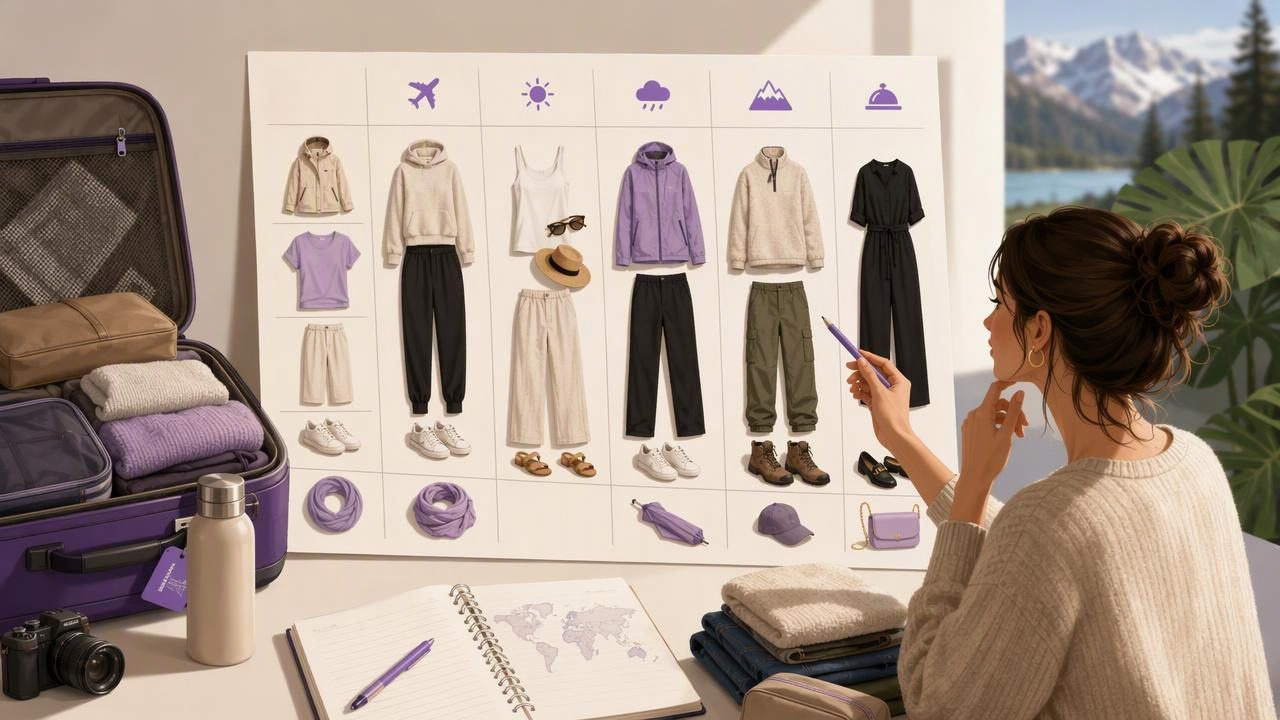
A trip outfit planner helps you answer a deceptively difficult question before you leave home: what will I actually wear each day? Rather than packing individual items based on vague possibilities, you can plan complete looks around your itinerary, expected weather, laundry access, and personal comfort.
The result is not a rigid schedule that falls apart when plans change. A useful travel wardrobe plan is a flexible system. It gives you enough outfit combinations for sightseeing, dinners, transit days, and unexpected temperature shifts without filling a suitcase with “just in case” pieces you never wear.
This guide explains how to create a practical packing matrix—a simple method for matching clothing to travel days and activities. It is especially helpful for travelers who want more confident outfit planning, whether they are packing for a long weekend, a work trip, or a multi-city holiday.
What Is a Trip Outfit Planner?
A trip outfit planner is a method for organizing clothes into wearable combinations before a trip. Instead of making a list such as “three tops, two pants, one dress,” you create specific outfits from the garments you already own.
That distinction matters. Three tops and two pants may technically create six combinations, but only if the colors, proportions, layers, shoes, and occasion level work together. Planning full looks in advance reveals gaps early, such as discovering that every dinner outfit needs the same shoes or that your preferred trousers do not work with your rain jacket.
Your planner can be as simple as a notebook page, spreadsheet, packing board, or digital closet. The important part is that it connects:
- Your destination and forecast
- Your day-by-day itinerary
- The clothes you genuinely enjoy wearing
- Outfit alternatives for weather or plan changes
- A final packing list based on proven combinations
Why Plan Outfits Before Making a Packing List?
Packing lists are useful, but they often focus on quantities rather than function. A trip outfit planner starts with function: what you will do, how formal it is, how long you will be out, and what conditions you may encounter.
For example, “bring a sweater” is not as useful as “wear the lightweight knit over the striped shirt for the museum day, and pair it with dark jeans for the casual dinner.” The second note tells you why the sweater earns a place in your bag and shows that it works twice.
| Planning by Item Count | Planning by Outfit Combination |
|---|---|
| “Pack two pairs of shoes.” | “White sneakers work for walking; black loafers work for dinner and work meetings.” |
| “Bring a jacket.” | “The trench layers over all daytime outfits and handles light rain.” |
| “Pack extra tops.” | “Each top pairs with both bottoms and works under the same outer layer.” |
This approach reduces duplicate items while making your suitcase more useful. You are not trying to bring an outfit for every imaginable scenario. You are choosing a small set of garments that can adapt to the scenarios most likely to happen.
Step 1: Turn Your Itinerary Into Clothing Needs
Begin with your actual schedule, not your idealized vacation wardrobe. Write down travel days, reservations, work commitments, outdoor activities, and any events with a dress code. Then assign each activity a clothing need.
Use categories that are specific enough to guide decisions:
- Transit: comfortable, layered, easy to move in
- Walking or sightseeing: supportive shoes, weather-ready layers, secure bag
- Dining: a slightly elevated look that still suits the destination
- Work or meetings: polished pieces that travel well
- Active plans: activity-appropriate clothing, socks, and outerwear
- Rest or hotel time: sleepwear, lounge clothing, swimwear if needed
Next, identify the highest-risk days. These are usually a long flight, a formal dinner, a weather-exposed activity, or a day that moves directly from daytime plans to an evening reservation. Give these days more attention than low-stakes coffee runs.
Example: Four-Day City Break
Imagine a four-day city trip with mild weather, possible rain, lots of walking, and one nice dinner. A clear planner might look like this:
| Day | Main Plans | Primary Outfit | Backup or Layer |
|---|---|---|---|
| Day 1 | Train travel and casual dinner | Dark jeans, soft tee, overshirt, sneakers | Lightweight jacket for evening |
| Day 2 | Museums and walking tour | Black trousers, striped shirt, sneakers | Trench coat and compact umbrella |
| Day 3 | Markets and dinner reservation | Midi dress, jacket, loafers | Jeans and knit if rain is heavy |
| Day 4 | Brunch and return travel | Repeat trousers, tee, knit, sneakers | Overshirt for cooler transit |
Notice that the plan repeats trousers, shoes, and layers. Repeating items is not a planning failure—it is the point. A cohesive travel wardrobe relies on dependable pieces used in multiple ways.
Step 2: Choose an Anchor Color Palette
To create more outfits from fewer garments, select two to three anchor neutrals and one or two accent colors. Your anchors might be black, cream, and denim blue. Your accents could be rust and forest green. This does not mean every item must match perfectly; it means each piece should connect with several others.
When evaluating an item, ask three questions:
- Can I wear it with at least two other packed items?
- Does it work with my main shoes and outer layer?
- Would I be happy wearing it for the activity on my itinerary?
If the answer is no, it may be a great item for another occasion—but not a valuable travel item for this particular trip.
Simple rule: Pack statement pieces only when the supporting pieces are already in your plan. A bold top that works with one bottom, one shoe, and one event is often less useful than a versatile layer you can wear four times.
Step 3: Build a Packing Matrix, Not a Perfect Daily Uniform
A packing matrix shows how garments work across multiple outfits. It prevents you from packing pieces that only work in one photograph or one imagined situation.
Start by listing your core garments: bottoms, tops, layers, shoes, and one or two occasion-specific pieces. Then mark the combinations that work. You do not need to calculate every possible pairing. Focus on combinations you would realistically choose.
| Garment | Ways It Can Be Used | Trip Role |
|---|---|---|
| Black trousers | Striped shirt, tee and knit, dressy blouse | Walking, dinner, travel |
| Dark jeans | Tee and overshirt, blouse and jacket | Transit, casual evenings |
| Light knit | Over tee, over shirt, with dress | Cool mornings, air-conditioned spaces |
| White sneakers | All daytime looks, travel outfit | Walking comfort |
Look for weak links. If one top requires a separate bra, shoe, bag, or jacket that you otherwise would not bring, decide whether it deserves the space. Likewise, if two garments have identical roles, choose the one that is more comfortable, easier to wash, or more adaptable.
Step 4: Plan for Weather Changes Without Overpacking
Weather uncertainty is one of the main reasons people overpack. The solution is not bringing clothing for every temperature. It is building layers that work together.
A practical layering system usually includes:
- A breathable base layer, such as a tee, shirt, or sleeveless top
- A warm mid-layer, such as a knit, cardigan, or overshirt
- An outer layer appropriate for wind or rain
- Shoes that suit the amount of walking and likely conditions
Check the forecast close to departure, but use climate patterns as well. A destination with warm afternoons may still have cold mornings, strong wind, or heavily air-conditioned restaurants. Select layers that fit over more than one outfit instead of bringing a separate jacket for each look.
Be realistic about your tolerance for discomfort. If you dislike wet shoes, a forecast with rain should influence your shoe plan. If you get cold easily, a thin jacket may not be enough simply because it looks right in a photo.
Step 5: Add One Backup Look for High-Stakes Plans
You do not need a backup outfit for every day. But one alternate look can remove stress when a key plan changes. Choose it for the activity where you care most about feeling prepared: a business meeting, special dinner, wedding-related event, or outdoor excursion.
For the city-break example, the backup might be black trousers, a dressy blouse, loafers, and the same jacket used elsewhere. It gives the traveler an alternative to the midi dress if the weather turns wet or the dinner venue feels more formal than expected.
Keep the backup modular. Ideally, it should use items already assigned to other outfits. Packing an entirely separate emergency ensemble adds bulk and makes the rest of the suitcase less efficient.
Step 6: Review Your Plan for Comfort, Care, and Laundry
Before finalizing your trip outfits, do a practical review. Ask whether each garment is comfortable for its assigned activity, whether it wrinkles easily, and whether it can be reworn. This is where a visually appealing plan becomes a useful one.
- Can you walk several miles in the planned shoes?
- Will the fabric feel comfortable during long travel days?
- Can you rewear trousers, layers, and outerwear?
- Is there laundry access for longer trips?
- Do your accessories work across outfits rather than with only one look?
Also separate style planning from fit and performance decisions. Visualizing an outfit can help you compare color, silhouette, and layering, but it cannot guarantee exact sizing, comfort, fabric behavior, or how a garment will feel after hours of travel. Try on unfamiliar combinations before you leave whenever possible.
Make Your Travel Wardrobe Easier to Reuse
The best trip outfit planner does more than organize one journey. Save the combinations that worked well, note what stayed unworn, and record any packing lessons. Over time, you will learn which layers travel best, which shoes earn their space, and which “versatile” items are not actually useful for your routine.
If you prefer to plan visually from clothes you already own, Outfit Maker’s guide to planning travel outfits explains how a digital closet can help you view garment combinations, organize looks, and save options before packing. Use the visual plan as a decision tool, then confirm comfort and fit with a real-life try-on.
With a clear itinerary, a repeatable color palette, and a packing matrix built around real outfit combinations, you can leave with fewer clothes and more confidence about what to wear each day.