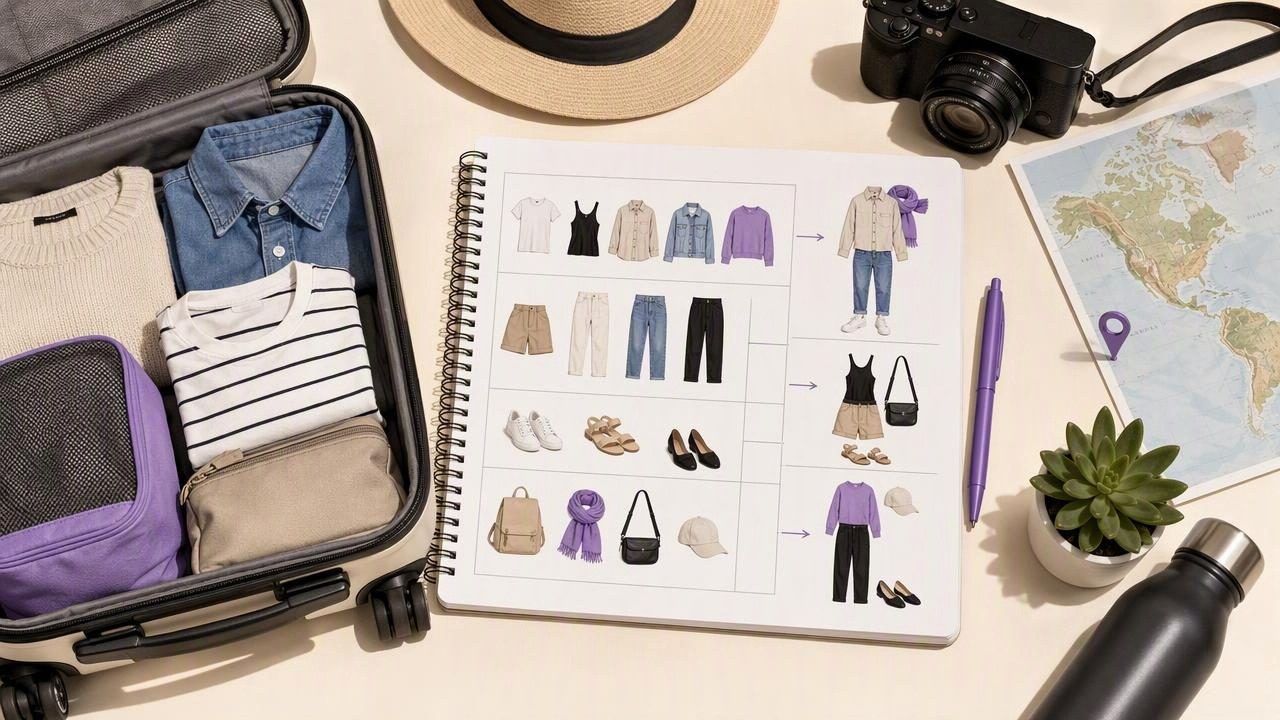
A travel packing outfit planner helps you decide what to wear before your suitcase is open on the bed and your departure time is approaching. Rather than packing individual items that seem useful on their own, you plan complete outfit combinations around your itinerary, weather, laundry access, and personal style.
The result is a more practical travel wardrobe: fewer “just in case” pieces, more outfits you genuinely want to wear, and less time spent getting dressed in an unfamiliar hotel room. Whether you are taking a two-day city break, a week at the beach, or a multi-stop work trip, planning outfits first can make packing feel far more manageable.
This guide explains how to build a travel wardrobe that works across multiple days without assuming every item will fit every situation. It also includes a concrete packing example and important limitations to keep in mind when using digital tools for fashion planning.
Why Plan Outfits Before You Pack?
Many travelers pack by category: several tops, several bottoms, a few pairs of shoes, and extra layers. This approach can create a full suitcase without guaranteeing that the pieces work together. A shirt may look good with only one pair of trousers. Shoes may be comfortable but unsuitable for an evening reservation. A jacket may be too bulky for the forecast.
Planning by outfit changes the question from “What clothes might I need?” to “What will I wear for each part of this trip?” That shift makes it easier to identify gaps, repeats, and unnecessary items before packing.
- Less overpacking: Each item has a role in at least one planned look.
- More outfit variety: A small set of compatible garments can create several combinations.
- Faster mornings: You have already made many clothing decisions at home.
- Better preparation: Formal dinners, long walking days, transit days, and weather changes are considered early.
- Easier laundry planning: You can intentionally repeat durable basics instead of accidentally running out of clean clothes.
Start With the Trip, Not the Clothes
An effective travel packing outfit planner begins with the conditions of the trip. Your wardrobe should support what you will actually do, not just reflect your usual closet habits. Write down the destination, dates, forecast range, travel method, planned activities, and any dress codes.
It helps to divide your itinerary into practical clothing moments. For example, “four days in Lisbon” is broad. “Flight day, walking tour, casual dinner, museum afternoon, outdoor viewpoint, nicer restaurant, and return flight” gives you useful planning categories.
Create an activity and outfit map
| Trip activity | Clothing needs | Outfit planning question |
|---|---|---|
| Travel day | Comfort, layers, accessible pockets | Can I sit, walk, and handle changing temperatures comfortably? |
| Long walking day | Supportive shoes, breathable layers | Will this still feel comfortable after several hours? |
| Casual meal | Easy, polished separates | Can I use pieces already worn earlier that day? |
| Evening event | Appropriate dress level, practical outerwear | What one item makes the outfit feel more intentional? |
| Weather change | Rain, wind, cold, or heat protection | Which layer works with more than one outfit? |
Do not plan a completely separate wardrobe for every line of an itinerary. The purpose is to find overlaps. One pair of dark trousers may suit a train journey, a museum visit, and dinner when styled with different tops or accessories.
Choose a Flexible Travel Color Palette
A limited color palette is one of the simplest ways to create more outfit combinations from fewer garments. This does not mean every item must be black, beige, or neutral. It means your chosen colors should be easy to combine.
Start with two or three foundation colors, then add one or two accents. For instance, navy, cream, and olive can form a practical base, while rust or soft blue adds interest. A traveler who prefers brighter style could use black, white, and denim as anchors with red and cobalt accents.
Before adding an item to your packing list, ask: Can I wear this with at least two other planned pieces? If the answer is no, it may still deserve a place for a special occasion, but it should be an intentional exception rather than an automatic addition.
Build a Travel Capsule Around Outfit Formulas
An outfit formula is a repeatable structure, such as “relaxed trousers + fitted top + overshirt” or “dress + light layer + walking shoes.” Formulas reduce decision fatigue while leaving room for different colors, fabrics, and accessories.
For a short trip, choose three to five formulas that match your itinerary. Then select garments that can move between them.
- Jeans or tailored trousers + knit top + lightweight jacket
- Midi skirt or relaxed trousers + tucked-in shirt + comfortable sneakers
- Dress or matching set + layer + versatile flat shoe
- Dark trousers + elevated top + simple jewelry for dinner
- Leggings or soft trousers + tee + overshirt for travel
The goal is not to force every garment into every formula. Instead, make sure your key pieces connect. If one jacket works with five looks, it earns more suitcase space than a statement layer that works with only one.
A Concrete 5-Day City Trip Packing Example
Imagine a five-day spring city break with mild temperatures, a chance of rain, lots of walking, two casual dinners, and one nicer evening reservation. The traveler wants carry-on-only packing and has access to no laundry.
A compact outfit plan could include:
- 2 bottoms: dark straight-leg trousers and medium-wash jeans
- 1 optional alternative: a midi skirt or comfortable dress
- 4 tops: two neutral tees, one button-up shirt, and one fine knit
- 2 layers: lightweight waterproof jacket and structured overshirt or cardigan
- 2 shoes: supportive sneakers and versatile loafers, flats, or low boots
- 1 small bag, sleepwear, underwear, socks, and weather-specific essentials
From those pieces, the traveler can plan the following looks:
- Travel day: Jeans, neutral tee, overshirt, sneakers.
- Walking and sightseeing: Dark trousers, tee, waterproof jacket, sneakers.
- Casual dinner: Dark trousers, button-up shirt, loafers or flats.
- Museum and coffee stop: Midi skirt or dress, cardigan, sneakers.
- Nicer evening: Dark trousers or skirt, fine knit, simple accessories, dressier shoes.
- Return journey: Jeans, clean tee, overshirt, sneakers.
This plan intentionally repeats trousers, layers, and shoes. Repeating is not a packing failure; it is how a small travel wardrobe becomes efficient. The visual variety comes from changing the top, layer, shoe, or accessory rather than adding several extra standalone garments.
Use a Digital Outfit Board Before You Fold
Seeing garment combinations together can reveal issues that are hard to notice when clothes are hanging separately. A digital wardrobe or simple outfit board lets you group images of your items, compare looks, and label them by day or activity.
For each planned outfit, make a note of its purpose: “airport,” “rainy afternoon,” “dinner,” or “long walking day.” Then check whether an item appears only once. If it does, decide whether that single use is important enough to justify the space it takes.
Digital planning is particularly helpful when your suitcase contains clothes from different seasons or storage areas. Photographing items in advance can help you compare colors and silhouettes without repeatedly pulling everything out.
Practical rule: Pack the outfit you can clearly describe, not the item you vaguely imagine wearing.
Check Each Outfit for Real-World Travel Conditions
A photo or outfit board can help with style visualization, but it cannot replace practical checks. Before finalizing your travel packing list, assess every outfit for comfort and function.
- Can you walk comfortably in the selected shoes for the planned distance?
- Does the outfit work with the weather layer you are bringing?
- Will the fabric wrinkle easily in transit?
- Can you adjust for a warmer afternoon or a cooler evening?
- Do you have the right undergarments, socks, bag, and outerwear?
- Does the outfit meet any cultural, professional, or venue-specific expectations?
Try on the most important outfits at home, especially those for formal events, travel days, or uncertain weather. Check that shoes are broken in and that layers fit comfortably over the garments beneath them.
Important Limits of Virtual Outfit Planning
Digital planning tools and AI try-on imagery can make it easier to visualize colors, proportions, and outfit combinations from your own garments. They are useful for narrowing down options and remembering looks you liked. However, they should not be treated as exact predictions of fit, sizing, fabric behavior, or comfort.
A visualization may not show whether a waistband feels restrictive after a flight, whether linen creases in a suitcase, whether fabric is warm enough for an evening breeze, or whether a shoe causes blisters after several miles. Lighting, photo angle, and garment images can also affect how colors and proportions appear on screen.
Use visual planning as a decision aid, then verify your final travel looks in real conditions. This combination of organization and practical testing is more reliable than relying on either one alone.
Final Packing Review: Remove the “Maybe” Items
Before you zip the suitcase, do one final review. Lay out your planned outfits or view them together digitally. Count how many times each major piece appears, and look for duplicates that perform the same job.
If you have two nearly identical sweaters, three pairs of shoes for similar casual use, or a top that matches nothing else, remove one. Keep exceptions only when they serve a known purpose, such as a formal event, a required workout, or a major weather change.
A useful final question is: Would I choose this item over another packed item on a real day of the trip? If not, leave it at home.
Make Travel Outfit Planning a Repeatable Habit
The more often you plan trips this way, the faster it becomes. Save your successful outfit combinations, note what went unworn, and record any comfort problems after you return. Over time, you will learn which shoes travel well, which fabrics suit your destinations, and which layers provide the most versatility.
For people who prefer to organize garments visually, Outfit Maker’s guide to planning travel outfits offers a helpful starting point for using a digital closet to map combinations from clothes you already own. The best travel packing outfit planner is ultimately the one that helps you pack with intention, dress comfortably, and spend more of your trip enjoying the destination.