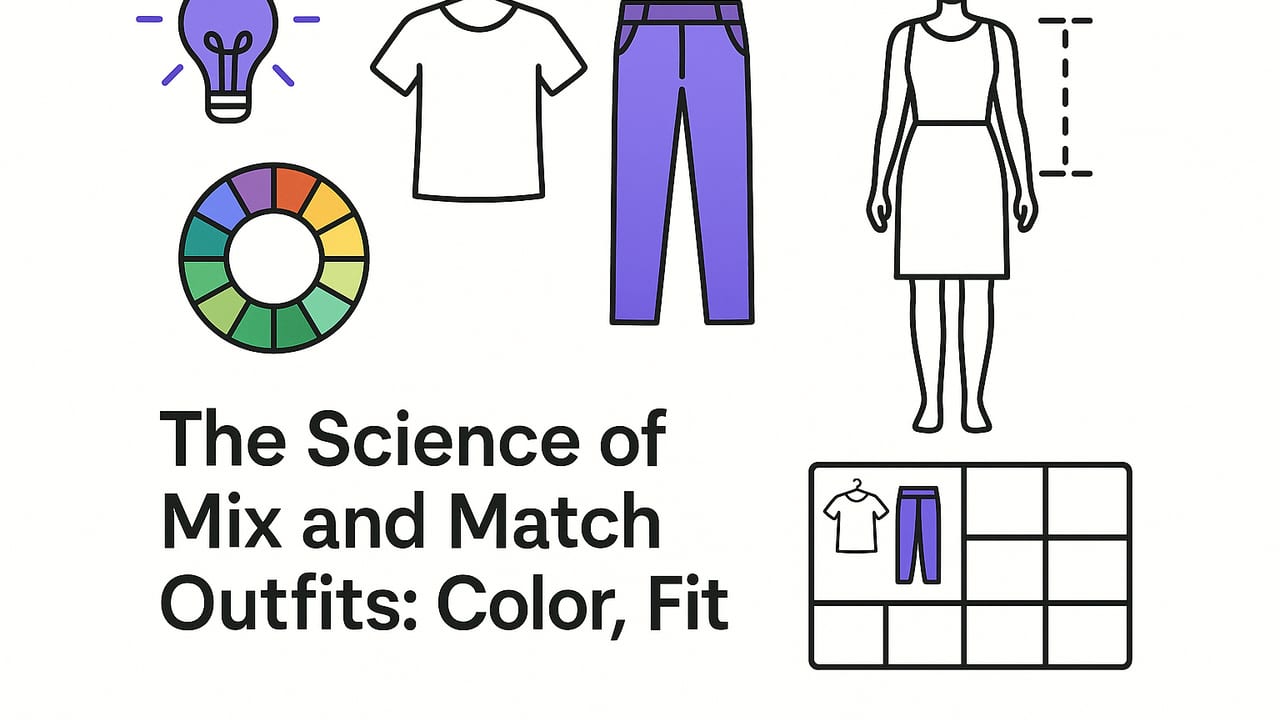
Great style isn’t about owning more clothes—it’s about extracting more possibilities from what you already have. A repeatable system for mix and match outfits helps you get dressed faster, spend less, and look more intentional day after day. In this guide, you’ll learn practical formulas for color, proportion, and texture, plus a simple outfit matrix you can replicate for work, weekends, travel, and events.
Why Mix and Match Outfits Work
When pieces share a common “language”—color, silhouette, texture, or function—they combine smoothly. The result: fewer dead-end garments, fewer decision bottlenecks, and more wearable looks. A good framework turns your closet into a modular system instead of a collection of one-off items.
Style becomes effortless when your wardrobe is a set of compatible modules, not isolated statements.
Start with a Modular Core Wardrobe
Build a nucleus of items that anchor most of your mix and match outfits. Think of these as “connectors” that pair well across seasons and settings.
- Tops (5–7): 2 tees, 2 shirts/blouses, 1 knit, 1 elevated top, 1 layering turtleneck.
- Bottoms (4–5): 1 dark denim, 1 light/medium denim, 1 tailored trouser, 1 relaxed trouser, optional skirt.
- Third Pieces (3–4): Blazer, cardigan, light jacket, statement outerwear.
- Shoes (3–4): Clean sneaker, smart flat/loafer, boot, dress shoe/heel.
- Accessories: Belt, watch, scarf, everyday jewelry, practical bag plus one accent bag.
Keep most core pieces in versatile neutrals to maximize cross-compatibility, then layer in accents for personality.
The Outfit Equation
Use this simple template to generate consistent, polished looks:
Base (top + bottom in cohesive colors or textures) + Interest (print, texture, or color pop) + Third Piece (layer that adds structure or cohesion) + Bridge (accessory or element that links colors/materials)
Example: navy tee + stone trousers (Base) + striped scarf (Interest) + camel blazer (Third Piece) + tan belt and brown loafers (Bridge).
Color Strategy for Mix and Match Outfits
Color is the fastest lever for compatibility. Choose a primary neutral family, one secondary neutral, and two to three accent shades. Metallics act like neutrals that tie looks together.
| Base Neutral | Secondary Neutral | Accent Colors | Metallics | Notes |
|---|---|---|---|---|
| Navy | Stone/Beige | Rust, Forest, Sky Blue | Silver | Cool-leaning; crisp with white, refined with camel. |
| Black | Charcoal | Cobalt, Fuchsia, Emerald | Gunmetal | High-contrast; anchor bold accents or sleek monochrome. |
| Chocolate | Cream | Olive, Burnt Orange, Blush | Gold | Warm palette; ideal for earth tones and natural textures. |
| Gray | White | Pastels, Burgundy, Teal | Mixed | Chameleon neutral; pairs with both warm and cool accents. |
- Undertones: Cool undertones (blue/pink) favor navy, gray, jewel tones; warm undertones (yellow/olive) favor brown, camel, earth tones. Neutral undertones can flex.
- Bridging prints: Stripes, checks, or florals that include your base neutral plus an accent color connect multiple looks.
- Monochrome magic: Vary textures and values (light/dark) within a single color for sophisticated outfits with minimal effort.
Silhouette and Proportion Rules
Compatibility isn’t just color. The most wearable mix and match outfits balance volume and length:
- One fitted + one relaxed: Slim top with wide-leg pants, or oversized sweater with tapered trouser.
- Rule of thirds: Aim for a 1/3 top to 2/3 bottom proportion (or vice versa) rather than a 1/2 split. Use tucks, belts, or croppings to adjust.
- Structure vs. drape: Pair structured blazers with fluid trousers; pair soft cardigans with tailored pants for contrast.
- Hem hierarchy: If the bottom is long/voluminous, keep the top cropped or tucked. If the top is long, slim the bottom.
Texture and Print Mixing
Textures add depth; prints add focal points. Combine them deliberately:
- 3-2-1 Guideline: One print, one noticeable texture (e.g., rib knit, suede), one smooth solid.
- Scale harmony: Mix one large-scale print with a micro-pattern to avoid competition.
- Material echo: Repeat a texture once (e.g., suede belt echoes suede boots) to make the choice feel intentional.
Create Your Outfit Matrix
An outfit matrix turns your closet into combinatorial power. Start with a grid of tops, bottoms, and third pieces that share your color and silhouette rules.
- Select 5 tops, 4 bottoms, 3 third pieces, 3 pairs of shoes in a coherent palette.
- Ensure at least 80% neutral coverage among tops/bottoms.
- Audit each top with each bottom: pass/fail based on color and proportion.
- Map third pieces that improve at least 60% of those pairings.
- Add accessories that bridge color and texture.
Simple math reveals the potential:
# rough combo estimator
T = 5  # tops
B = 4  # bottoms
L = 3  # third pieces (layers)
S = 3  # shoes
# Assume 80% of top-bottom pairs work, and 2/3 of those work with a layer
pairs = int(T * B * 0.8)
layered = int(pairs * (2/3))
looks = pairs + layered
total = looks * S
print(total)  # estimated distinct outfits
Even conservatively, you can produce dozens of mix and match outfits from a small capsule.
Scenario Playbook: Work, Weekend, Travel, Evening
Work
- Base: Navy trouser + light blue shirt.
- Third Piece: Gray blazer.
- Bridge: Brown belt/loafers, silver watch.
- Swap: Strip blazer for cardigan on casual days; add a print scarf for interest.
Weekend
- Base: White tee + light denim.
- Third Piece: Olive overshirt or denim jacket.
- Bridge: Clean sneakers, canvas tote with olive stripe.
- Swap: Replace tee with Breton stripe; swap sneakers for boots.
Travel
- Base: Stretch trouser + wrinkle-resistant knit.
- Third Piece: Lightweight blazer or chore jacket with pockets.
- Bridge: Neutral scarf that doubles as a blanket; slip-on shoes.
- Swap: Turn the knit into an evening piece with a statement necklace or silk scarf.
Evening
- Base: Black jean or trouser + satin/silk top.
- Third Piece: Cropped jacket.
- Bridge: Metallic belt or clutch; coordinated jewelry.
- Swap: Monochrome head-to-toe black with varied textures for instant polish.
Accessories and Shoes: The Multipliers
Accessories are the smallest investment with the largest outfit upside. Use them to bridge colors and upgrade basics.
- Belts: Repeat shoe color or metal tone to tie the look together.
- Scarves: Choose prints that contain two of your palette colors to connect disparate pieces.
- Jewelry: Keep a primary metal (gold/silver) for cohesion; use one statement piece at a time.
- Bags: One neutral everyday, one accent bag that energizes monochrome fits.
- Shoes: Pointed flats elongate, chunkier soles balance oversized tops; white sneakers modernize tailored pieces.
Care, Fabric, and Longevity
Maintenance choices impact how reliably pieces mix and match:
- Fabric families: Pair like with like for ease (e.g., cottons with cottons, wools with wools) or contrast textures intentionally.
- Wrinkle strategy: Knits, ponte, technical blends reduce upkeep and travel well.
- Laundry palette: Staying within a palette safeguards against dye bleed disasters and simplifies washing.
- Tailoring: Hemming for your shoe heights and tapering key pieces dramatically improves mixability.
Common Mistakes (and Fixes)
- Too many orphans: A statement item that matches nothing. Fix: Introduce a bridging accessory or a neutral layer that echoes one color.
- Palette drift: Random buys that break your scheme. Fix: Save your palette as a reference when shopping.
- Proportion clashes: Oversized-on-oversized with no structure. Fix: Add a waist-defining belt or a sharper third piece.
- Print competition: Multiple large prints. Fix: Use one hero print with a micro-pattern or textures.
- Wrong footwear scale: Delicate shoes under heavy trousers. Fix: Match shoe visual weight to the bottom’s volume.
- Neglecting outerwear: The coat is the outfit in colder months. Fix: Own at least one coat that flatters your core palette and silhouette.
- Skipping the bridge: Colors feel random. Fix: Repeat a shade or metal at least twice.
- Ignoring comfort: Beautiful but impractical pieces never get worn. Fix: Prioritize fabrics and fits you’ll reach for.
The 10-Day Mix and Match Challenge
- Day 1: Pick your palette: one base neutral, one secondary, two accents, one metallic.
- Day 2: Pull 5 tops, 4 bottoms, 3 third pieces, 3 shoes into a staging area.
- Day 3: Test each top-bottom combo; photograph keepers.
- Day 4: Add third pieces to at least 60% of keepers; photograph.
- Day 5: Add accessories that bridge or add interest.
- Day 6: Build three work looks.
- Day 7: Build three weekend looks.
- Day 8: Build two travel-ready looks.
- Day 9: Build two evening looks.
- Day 10: Review your photos, note gaps to fill (e.g., a cream belt, a lighter sneaker, a versatile knit).
Smart Tools and Simple Workflows
- Photograph inventory: Lay garments flat in good light against a plain background; capture front, detail, and label if relevant.
- Tag and group: Label by color family, season, dressiness, and silhouette so you can filter combinations fast.
- Batch plan: Build next week’s outfits in one 20-minute session; save backups for weather swings.
- Virtual try-on: Test color and proportion pairings digitally before pulling everything out; it saves time and laundry.
If you prefer a visual, tech-assisted approach, an AI outfit generator and digital wardrobe planner like Outfit Maker for iOS can help you upload pieces, experiment with combinations, and save the best looks for quick recall.
Final Thoughts
Mix and match outfits thrive on clear parameters: a tight color palette, balanced proportions, and intentional textures. Start small, document what works, and refine over time. With a modular mindset and a simple outfit matrix, you’ll multiply your options without multiplying your closet—and getting dressed will feel like a solved problem.