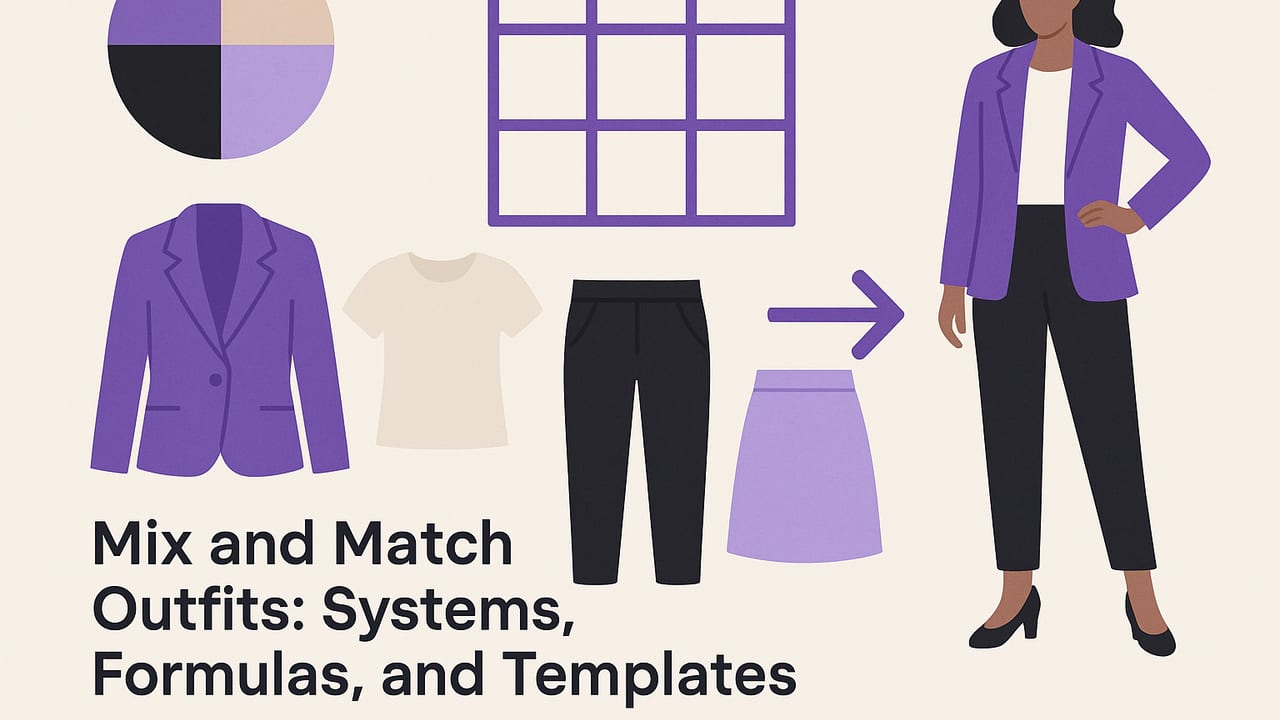
If you want to get more looks from fewer clothes, mastering how to mix and match outfits is the highest-ROI skill in your wardrobe. It reduces decision fatigue, increases cost-per-wear, and makes your closet feel bigger without buying more. Below you’ll find a practical, step-by-step system: color palettes that always work, silhouette rules, a 3×3 wardrobe grid, outfit formulas for common scenarios, and templates you can start using this week.
What “mix and match” really means
Mix and match isn’t random. It’s a repeatable method for combining pieces so they harmonize by color, proportion, and texture. Done right, nine thoughtfully chosen items can yield 25–30 outfits that look intentional—not repetitive.
- Versatile color palette: Neutrals do the heavy lifting; accents add personality.
- Complementary silhouettes: Balance volume and fit so pieces layer cleanly.
- Texture/print strategy: Limit statement elements and link them through color.
- Repeatable formulas: A few templates solve most daily dressing needs.
Pro tip: Every item should work with at least three others in your closet. If it doesn’t, it’s a poor team player.
Build a palette that multiplies combinations
Color is the fastest way to unlock mixability. Choose 2–3 neutrals as your base and 2 accents for interest. Keeping saturation and temperature consistent makes almost everything combine smoothly.
Choose your base neutrals
- Cool bases: black, charcoal, navy, optic white
- Warm bases: chocolate, camel, olive, cream
- Soft bases: stone, taupe, mid-grey, ecru
Add 2–3 accent colors
Pick accents that echo your neutrals’ undertone. For example, navy pairs well with burgundy and forest; camel loves rust and denim blue.
| Neutral Base | Accent 1 | Accent 2 | Why It Works |
|---|---|---|---|
| Black + White | Cobalt | Emerald | High contrast; jewel tones pop without clashing. |
| Navy + Grey | Burgundy | Forest | Cool undertones; rich, office-friendly palette. |
| Camel + Cream | Rust | Denim Blue | Warm harmony; elevated casual feel. |
| Olive + Khaki | Mustard | Off-white | Earthy cohesion; great for outdoor/travel. |
Silhouettes that always work together
Even perfect colors fail if proportions fight each other. Use these pairing rules to make layering easy and flattering.
- Fitted + Volume: Slim top with wide-leg pants, or roomy knit with tapered bottoms.
- Long over lean: Longline blazer/coat over straight or skinny trousers/jeans.
- Crop to define: Cropped top or jacket meets high-rise bottoms for waist emphasis.
- Third-piece balance: Add a blazer, overshirt, or cardigan to tie top and bottom together.
The 3×3 Wardrobe Grid
The simplest mix-and-match framework: choose 3 tops, 3 bottoms, and 3 layers that share a palette and compatible silhouettes. You’ll get dozens of combinations without feeling repetitive.
Combination math: Tops × Bottoms × Layers = outfit options. For a basic set: 3 × 3 × 3 = 27 looks. Even if you exclude a few outliers, you’ll comfortably clear 20+ unique outfits.
| Category | Item | Notes |
|---|---|---|
| Top | White knit tee | Slim fit to layer under blazers/cardigans |
| Top | Navy poplin shirt | Structured; works tucked or layered |
| Top | Striped long-sleeve tee | Low-contrast stripe acts as a neutral print |
| Bottom | Charcoal tailored trouser | Tapered; ankle length for multiple shoe types |
| Bottom | Dark straight-leg jean | No distressing for dress-up/down flexibility |
| Bottom | Camel midi skirt | Fluid fabric; balances structured tops |
| Layer | Navy blazer | Longline, slightly relaxed |
| Layer | Cream cardigan | Soft texture for contrast |
| Layer | Olive utility jacket | Casual third piece for weekend looks |
Shoe and bag choices (not counted in the grid) can double perceived variety. Aim for one dressy shoe (loafers or heels), one casual shoe (white sneaker), and one boot.
The 10×10 Challenge (advanced practice)
Pick 10 items (tops, bottoms, layers, shoes) and create 10 days of outfits. The constraint pushes creativity and reveals your most mixable pieces.
- 2 layers: tailored blazer, casual jacket
- 3 tops: tee, button-up, lightweight knit
- 3 bottoms: trouser, jean, skirt
- 2 shoes: white sneaker, leather loafer/ankle boot
Optional add-ons: a statement belt or scarf, one accent bag. These accessories inject personality without breaking the limit.
Outfit formulas for common scenarios
Office or meetings
- Structured blazer + knit tee + tapered trouser + loafers
- Poplin shirt + midi skirt + belt + block-heel
- Turtleneck + blazer + straight jean (dark) + ankle boots
Smart casual
- Cardigan worn as top + jeans + sleek belt + flats
- Utility jacket + striped tee + skirt + sneakers
- Poplin shirt half-tucked + jeans + loafers
Date night
- Blazer + silk cami + midi skirt + heels
- Monochrome knit + trouser + statement earring + boots
Travel day
- Stretch tee + cardigan + pull-on trouser + slip-on sneaker
- Utility jacket + knit + jean + crossbody bag
Gym-to-street
- Performance tee + bomber + tapered jogger + clean sneakers
Texture and print mixing cheat sheet
- Scale matters: Pair one small-scale print (pinstripe) with a larger one (wide stripe) if mixing two prints.
- Limit statements: One hero piece per outfit (bold print, high-shine fabric, or standout color).
- Link by color: Mixed prints work when they share at least one color.
- Use stripes like a neutral: Breton stripes, micro checks, and pinstripes play well with almost everything.
Seasonal swaps without breaking the system
Keep the formula; change the fabric and weight.
- Warm weather: Poplin, linen blends, light denim, unlined blazers.
- Cool weather: Merino, cashmere, corduroy, lined blazers, heavier denim.
- Shoes: Swap loafers for boots; canvas sneakers for leather.
A navy blazer in tropical wool, for instance, fills the same role as a navy tweed in winter—your color map stays intact, and mixing remains effortless.
Care, tailoring, and fit: the quiet multipliers
- Tailor hemlines: Ankles visible for flats/sneakers; longer for heels/boots.
- Press/steam: Crisp collars and sharp creases elevate basics immediately.
- Replace tired basics: Yellowed whites or pilled knits sabotage polished mixes.
Track usage and cost-per-wear
A simple log demonstrates which pieces earn their keep and which stall mixes. Reinvest where usage is highest.
| Item | Price | Wears | Cost per Wear |
|---|---|---|---|
| Navy blazer | $180 | 60 | $3.00 |
| Dark jean | $90 | 100 | $0.90 |
| Striped tee | $35 | 45 | $0.78 |
As a rule of thumb, aim for under $2 per wear on staples and under $5 on statement pieces.
A simple tagging schema to make outfits searchable
You can keep this in a notes app or spreadsheet to quickly filter for “work + warm weather + navy + smart casual.”
{
  "item_id": "top_001",
  "category": "top",
  "subcategory": "shirt",
  "color": "navy",
  "pattern": "solid",
  "fabric": "poplin",
  "silhouette": "regular",
  "season": ["spring", "summer", "fall"],
  "occasions": ["office", "smart-casual"],
  "warmth": 2,
  "notes": "works under blazer; half-tuck friendly"
}
Replicate the fields for each item. When planning outfits, filter by color, occasion, and season, then assemble using the silhouette rules and formulas above.
Common mistakes and quick fixes
- Too many statement pieces: If nothing mixes, you have a closet of soloists. Fix: Add high-quality neutrals in your base palette.
- Ignoring shoes: Footwear can make or break versatility. Fix: Own one dressy, one casual, one seasonal boot in your palette.
- Clashing proportions: Oversized + oversized can overwhelm. Fix: Balance volume with structure; mark the waist.
- Overcomplicating prints: Multiple loud prints compete. Fix: Treat stripes/pinstripes as neutrals; let one print lead.
Try it this week: a 5‑day mix-and-match plan
Using the 3×3 grid above, here’s a ready-to-wear schedule that demonstrates variety without adding items.
- Day 1 (Office): Poplin shirt + charcoal trouser + navy blazer + loafers
- Day 2 (Smart casual): Striped tee + dark jean + cream cardigan + sneakers
- Day 3 (Client meeting): White tee + midi skirt + navy blazer + block-heels
- Day 4 (Creative casual): Poplin shirt (half-tuck) + dark jean + olive utility jacket + loafers
- Day 5 (Dinner): White tee + midi skirt + cream cardigan (belted) + boots
Notice how each day reuses core pieces but shifts proportion, texture, or the third piece. That’s the essence of mix and match.
Building your personal template
- Pick your palette: 2–3 neutrals + 2 accents with consistent undertones.
- Audit silhouettes: Ensure tops layer under your chosen third pieces; confirm bottoms work with your common shoes.
- Create a 3×3: Start with 3 tops, 3 bottoms, 3 layers. Aim for 20+ viable combos.
- Define formulas by life area: Office, smart casual, travel, evening.
- Track wears: Identify MVPs; upgrade or duplicate those roles first.
Within a month, you’ll know your highest-performing colors, shapes, and fabrics—and you’ll be able to shop with precision instead of impulse.
Final thoughts
Mix and match outfits are less about owning more and more about owning the right few—pieces that share a palette, balance each other’s proportions, and adapt to multiple settings. Start with the 3×3 grid, apply the silhouette rules, and let your color map guide future purchases. If you want to experiment virtually before you wear it out, an AI outfit generator and digital wardrobe planner like Outfit Maker can help you visualize combinations from your own closet.