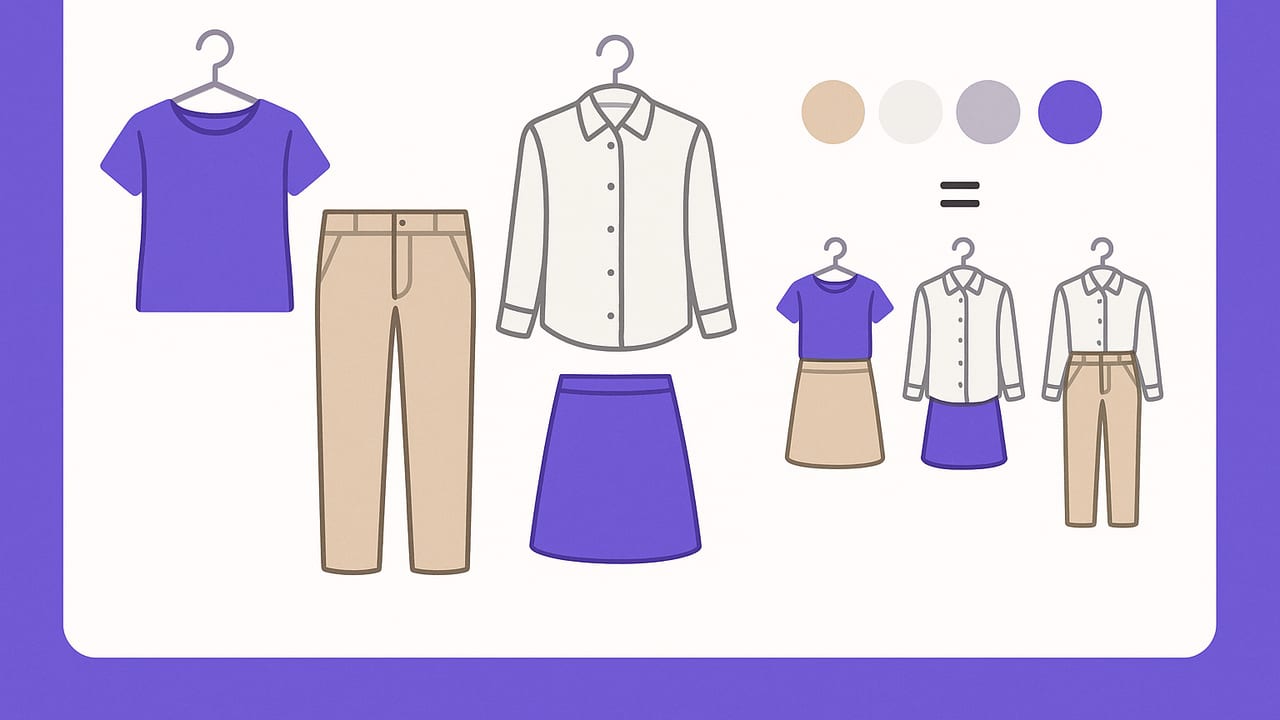
Mix and match clothing is the fastest way to turn a small closet into an abundant one. With the right color palette, silhouettes, and outfit formulas, a handful of pieces can generate dozens of wearable looks for work, weekends, travel, and events. This guide shows you how to build a modular wardrobe system that saves time, reduces decision fatigue, and gets real mileage from pieces you already own.
The Mix-and-Match Mindset
Before we dive into tactics, anchor on three principles that make mix-and-match work:
- Compatibility beats quantity: Ten coordinating items outperform thirty random ones.
- Formulas create speed: Repeatable outfit equations eliminate guesswork while still looking intentional.
- Constraints spark creativity: Limits—like a defined color palette—help you combine pieces in more interesting ways.
\u201cDon\u2019t add more clothes; add more ways to wear the clothes you love.\u201d
Build a Palette That Multiplies Outfits
Color is the backbone of a modular wardrobe. Choose a base (2–3 neutrals you wear most), a supporting neutral or two for depth, and 2–4 accents to add energy. Keep metals consistent to simplify accessories.
| Palette | Base Neutrals | Supporting | Accents | Metals | Prints |
|---|---|---|---|---|---|
| Cool Minimal | Black, charcoal | White | Ink blue, berry | Silver | Pinstripe, micro-check |
| Warm Everyday | Navy, camel | Ivory | Olive, rust, mustard | Gold | Houndstooth, small plaid |
| Earthy Casual | Chocolate, olive | Stone | Terracotta, sage | Antique brass | Floral ditsy, tonal stripe |
| Monochrome | Black, gray | White | Graphite, charcoal | Gunmetal | Glen check, zebra (tonal) |
| High-Contrast | Navy, white | Khaki | Red, cobalt | Polished gold | Breton stripe, polka dot |
Pro tips for choosing colors:
- Favor powders, mid-tones, or darks consistently; mixed depths are harder to pair.
- Let prints echo your palette so they connect multiple items at once.
- Match leather tones (belts, bags, shoes) to keep looks cohesive.
Proportion and Silhouette Rules That Always Work
Great mix-and-match clothing depends on balance as much as color. Use these quick rules to pair items fast:
- 2/3–1/3 rule: Aim for one larger visual block and one smaller. Example: long cardigan (2/3) + cropped jean (1/3).
- Fitted + relaxed: If one piece is roomy, keep the other closer to the body.
- Structured + fluid: Sharpen drapey fabrics with a tailored layer, or soften structure with a relaxed knit.
| Top Silhouette | Bottom Silhouette | Why It Works |
|---|---|---|
| Boxy tee | High-rise straight jean | Balances width on top with clean vertical line below. |
| Fitted turtleneck | Wide-leg trouser | Highlights waist; volume stays controlled. |
| Oversized shirt (half-tuck) | Pegged or tapered pant | Tuck defines the waist; taper elongates legs. |
| Cropped sweater | A-line or slip skirt | Short over long creates the 1/3–2/3 proportion. |
| Structured blazer | Relaxed jean | Tailoring refines casual denim; contrast feels intentional. |
Fabric, Texture, and Print Mixing
Texture and print are silent stylists. They determine how \u201cdressy\u201d a look reads and how easily pieces connect.
- Texture contrast: Pair matte (cotton, flannel) with sheen (silk, satin) to add depth.
- Weight harmony: Keep garment weights similar or anchor a light piece with a tailored layer.
- Print scale: Mix one small-scale print (micro-check) with one solid or larger motif; avoid two large prints together.
- Common color thread: Unify patterns through a shared neutral.
Outfit Formulas You Can Repeat
Use these plug-and-play equations to generate outfits quickly. Each formula accommodates multiple aesthetics by swapping colors, fabrics, and shoes.
Casual
- Tee + straight jean + lightweight jacket + low-top sneakers
- Breton stripe knit + barrel jean + loafers
- Hoodie + cargo pant + sleek runners
Smart Casual
- Silk blouse + dark denim + blazer + ankle boots
- Fine-gauge knit + midi skirt + belt + block-heel boots
- Oxford shirt + chinos + cardigan + loafers
Office
- Tailored blazer + shell + trousers + pumps
- Knit polo + pleated trouser + belt + derbies
- Sweater vest + button-down + pencil skirt + slingbacks
Evening
- Slip skirt + fitted turtleneck + leather jacket + heeled sandals
- Columns of color (top and bottom same tone) + statement earring
- Sheen-on-matte (satin top + wool trouser) + strappy heels
Footwear swaps that reframe a look in seconds:
- Sneakers \u2192 loafers: casual to polished
- Combat boots \u2192 Chelsea boots: edgy to streamlined
- Slides \u2192 strappy heels: daytime to dinner
The 10\u00d710 Wardrobe Grid
The 10\u00d710 method compresses decision-making: choose 10 pieces and create 10 days of outfits. It proves your closet\u2019s versatility and highlights gaps.
- Select 3 tops, 3 bottoms, 2 layers, 2 shoes within one palette.
- Ensure silhouettes interlock (see the table above).
- Create a quick matrix of combinations and note any holes.
| Code | Item | Notes |
|---|---|---|
| T1 | White fitted tee | Base layer, works under blazer |
| T2 | Blue Oxford shirt | Tucks and layers cleanly |
| T3 | Black fine-knit turtleneck | Smartens denim, evening-friendly |
| B1 | Dark straight jeans | Smart casual anchor |
| B2 | Navy pleated trousers | Office-ready, drapes well |
| B3 | Black slip skirt | Works with sneakers or heels |
| L1 | Charcoal blazer | Structure and polish |
| L2 | Camel cardigan | Soft contrast, cozy |
| S1 | White leather sneakers | Dress-down tool |
| S2 | Black block-heel ankle boots | Dress-up tool |
Potential combinations (sample): T1+B1+L1+S2, T1+B3+L2+S1, T2+B2+L1+S2, T3+B1+L2+S2, T2+B3+S1. With accessories (belt, earrings, scarf), you can easily hit 20–30 distinct looks.
Optional rules engine for planning
Use simple logic to steer choices by weather and dress code:
if weather.temp <= 50: choose(L1 or L2); add tights if wearing B3
if dress_code == "smart casual": prefer(B1 or B2); avoid distressed denim
if event == "presentation": choose(L1); pick S2; keep colors low contrast
if commute == "walking": choose S1; hem break slightly shorter
Seasonal Switching Without Rebuying
Keep your palette and swap fabrics and textures as temperatures change:
- Spring: Cotton knits, light denim, trench layers. Accents: lilac, sage, sky blue.
- Summer: Linen, seersucker, airy poplin. Add raffia/leather accessories; lighter shoes.
- Fall: Flannel, corduroy, merino. Warm accents like rust and olive; boots return.
- Winter: Wool, cashmere, velvet. High-contrast layers and structured outerwear.
Color tweaks: keep your base neutrals constant and rotate accents seasonally to maintain cohesion while refreshing outfits.
Occasion Smart-Swap System
Elevate or relax a base outfit using one-step swaps:
- Relaxed to refined: Tee \u2192 silk blouse, sneakers \u2192 loafers, canvas tote \u2192 structured bag.
- Office to evening: Cardigan \u2192 leather jacket, minimal stud \u2192 statement earring, matte lip \u2192 gloss.
- Weekend to travel: Jeans \u2192 wrinkle-resistant trouser, belt adds polish, scarf doubles as wrap.
Closet Process That Enables Mixing
A modular wardrobe is built as much by process as by shopping.
- Audit by category: Pull tops, bottoms, layers, shoes. Remove damaged or uncomfortable pieces.
- Sort by color and silhouette: Group by palette and fit (fitted, relaxed, cropped, long).
- Standardize hangers and folds: Visual uniformity makes mixing easier.
- Photograph key items: Create a simple digital catalog to plan outfits.
- Build micro-capsules: For work, weekend, and going out—ensure each has tops, bottoms, layer, shoes that cross over.
- Pre-plan 10 outfits: Save them as go-to looks for mornings or travel.
Common Pitfalls (and Quick Fixes)
- Too many statement pieces: Beautiful solo, hard together. Fix: Add anchor items (plain tees, dark jeans, solid skirts).
- Orphan colors: Single bright item with no friends. Fix: Introduce one accessory and one top with that hue.
- Fabric mismatch: Flimsy tops with heavy bottoms. Fix: Complement weights; add a structured layer to bridge.
- Shoe bottleneck: Only one shoe style limits combos. Fix: Cover three roles—sneaker, smart flat/loafer, dress shoe/boot.
- Fit drift: Items no longer align with silhouette rules. Fix: Tailor hems and waists; proportion is everything.
Quick Reference Checklist
- Palette: 2–3 base neutrals + 2–4 accents + one metal
- Silhouettes: pair fitted with relaxed; aim for 2/3–1/3 proportions
- Textures: mix matte and sheen; match garment weights
- Prints: one small-scale print + solids or one larger motif
- Footwear: maintain casual and dress shoes in your palette
- Formulas: save 5–7 outfit equations you love
- Plan: test a 10\u00d710 to reveal gaps and new combos
Putting It All Together
Mix and match clothing isn\u2019t about owning less or more\u2014it\u2019s about owning compatible. When your colors harmonize, silhouettes balance, and textures play well together, a modest selection of garments can power an entire season of style. Start with your palette, refine your silhouettes, then codify a few outfit formulas. As you iterate, document the winners and repeat them with small variations. If you want a low-effort way to test combinations before you wear them, Outfit Maker lets you digitize your closet and virtually try on looks to see what pairs best.