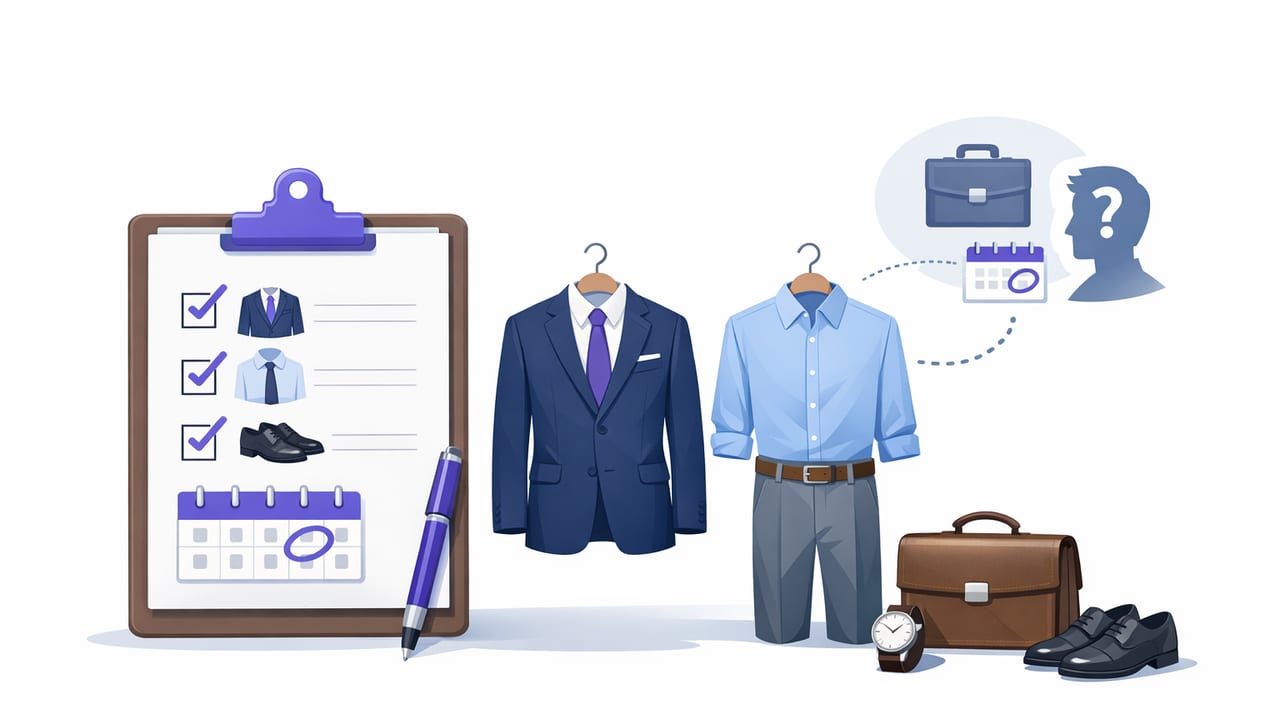
A great interview outfit isn’t about “having style.” It’s about reducing uncertainty so you can focus on your answers, your energy, and your communication. A job interview clothing planner for men gives you a repeatable system: you identify the dress code, choose reliable pieces, test the fit, and map complete outfits (including shoes and accessories) before interview day.
This guide breaks the process into practical steps you can do in under an hour—plus a few upgrades if you have more time.
Why a job interview clothing planner for men works
Interview nerves often spike because everything feels like a variable: what they’ll ask, who will be there, and what you should wear. Planning your outfit ahead of time eliminates one major variable. The benefits are simple:
- Consistency: you won’t improvise with mismatched pieces at the last minute.
- Confidence: you’ve already seen the full outfit together (in proper lighting).
- Time savings: the morning of the interview becomes routine, not a scramble.
- Better first impression: fit and appropriateness communicate judgment and professionalism.
Step 1: Decode the interview dress code (in 10 minutes)
Your first planning decision is the formality level. When in doubt, aim slightly more formal than the company’s day-to-day—without looking like you’re headed to a black-tie event.
Fast signals to look for
- Company photos: “Team” pages, LinkedIn posts, conference photos.
- Role context: client-facing roles typically skew more formal.
- Industry norms: finance/legal = formal; tech/creative = flexible; healthcare/admin = neat business casual.
- Recruiter cues: if they mention “business casual,” treat it as a floor, not a ceiling.
Dress code cheat sheet
| Dress code | Safest interview outfit | Avoid |
|---|---|---|
| Business Professional | Navy or charcoal suit, white or light-blue shirt, conservative tie, black or dark-brown oxfords | Bold patterns, fashion sneakers, loud accessories |
| Business Casual | Blazer + chinos or dress trousers, button-down shirt, optional tie, leather shoes/loafers | Wrinkled shirts, overly tight pants, worn-out shoes |
| Smart Casual / Tech Casual | Dark chinos, crisp button-down or fine knit polo, unbranded clean leather sneakers or loafers | Graphic tees, distressed denim, noisy logos |
Step 2: Build a small “interview capsule” (what to own or borrow)
Think of this as a mini uniform: a handful of items that mix easily and look sharp on camera and in person. If you’re creating a job interview clothing planner for men, start by listing what you already have and filling only the gaps.
Core capsule (covers most interviews)
- One blazer or suit jacket: navy is the most versatile; charcoal is a close second.
- Two shirts: white and light blue (they photograph well and look clean).
- Two bottoms: matching suit trousers (if wearing a suit) and a pair of dark chinos or dress trousers.
- One belt: match color to shoes (black with black; brown with brown).
- One pair of dress shoes: simple oxfords or derbies; keep them polished.
- One tie (optional): solid or subtle pattern (navy, burgundy, charcoal).
Colors that keep decisions easy
For interviews, neutral colors win because they’re predictable and professional:
- Navy / charcoal: trustworthy, classic.
- White / light blue: brightens your face and reads “clean.”
- Brown or black leather: choose one lane and stay consistent.
Step 3: Fit is the real “style” (use this checklist)
Even an expensive outfit looks off if the fit is wrong. Use this quick fit audit before you commit to an interview look:
- Shoulders: jacket seam sits at your shoulder edge (no divots, no overhang).
- Jacket closure: you can button without pulling or “X” wrinkles.
- Shirt collar: two fingers of space; no choking, no gaping.
- Sleeves: shirt cuff shows ~0.25–0.5 inch beyond the jacket sleeve.
- Trousers rise: comfortable when sitting; no constant tugging needed.
- Hem break: minimal break (clean line) is safest and modern.
- Shoes: no cracked leather, no worn-down heels.
Planning tip: If you can only improve one thing before an interview, improve fit—tailoring a jacket or trousers often beats buying something new.
Step 4: Create 2–3 complete outfits (not just “pieces”)
Your planner should include full looks: top, bottom, shoes, belt, outerwear, and a bag. Create at least two options:
- Primary outfit: the safest choice aligned with the company’s formality.
- Backup outfit: slightly more conservative (or slightly less formal) depending on uncertainty.
- Camera-friendly option: if you might do a video interview first.
Three reliable interview formulas
- Most formal: navy suit + white shirt + conservative tie + black oxfords.
- Most versatile: navy blazer + light blue shirt + charcoal trousers + dark-brown derbies.
- Smart casual: dark chinos + crisp button-down + lightweight blazer + clean leather sneakers (only if the company is truly casual).
Step 5: Pressure-test the outfit (the night-before routine)
A job interview clothing planner for men isn’t complete until you test it under real conditions. Do this the night before:
- Try it on head-to-toe and sit down for five minutes (wrinkles and tightness show up then).
- Check lighting: stand near a window and under indoor light; confirm colors look intentional.
- Do a pocket check: remove bulky items that distort lines (keys, thick wallets).
- Steam or iron: collars and plackets matter most on camera.
- Set a “launch pad”: shoes, belt, watch, and documents in one spot.
Grooming and details that interviewers notice
- Neckline + collar: clean, no fraying.
- Facial hair: either clean-shaven or sharply lined and intentional.
- Nails: trimmed (it’s subtle, but it reads as “put together”).
- Fragrance: minimal or none—small rooms amplify scent.
Step 6: Use a simple scoring matrix to choose the final look
If you’re torn between outfits, score them quickly. The goal is to pick the outfit that best communicates good judgment.
| Criteria | Score 1–5 | Notes |
|---|---|---|
| Appropriate formality for company/role | __ | When unsure, err slightly formal |
| Fit (standing and sitting) | __ | No pulling, no bunching, comfortable |
| Condition (wrinkles, scuffs, lint) | __ | Shoes and shirt collar weigh heavily |
| Distraction level (patterns, loud colors) | __ | Less is more for interviews |
| Confidence (do you feel like yourself?) | __ | Confidence beats “fashion” |
Step 7: Plan for video interviews (upper-body strategy)
Many interviews start on video. Your planner should include a camera-first version of the outfit:
- Choose solid colors: tiny checks can create a “moiré” shimmer on camera.
- Use a structured layer: a blazer instantly sharpens your silhouette on screen.
- Prioritize the collar area: wrinkles near the face show up more than pant wrinkles.
Quick video checklist
- Camera at eye level (not below)
- Front light (window or lamp), not strong backlight
- Neutral background if possible
- Test shot with your exact outfit
Example: a 7-day job interview clothing planner for men
If you’re interviewing across multiple companies or rounds, use a simple week plan so you’re never repeating a rumpled shirt or scrambling for laundry.
Interview Capsule Week Plan (Example)

Outfit A (Most Formal): Navy suit + White shirt + Navy tie + Black oxfords
Outfit B (Versatile):  Navy blazer + Light-blue shirt + Charcoal trousers + Brown derbies
Outfit C (Smart Casual): Dark chinos + White shirt + Blazer + Clean sneakers (if appropriate)

Mon: Outfit B (video screen test)
Tue: Outfit A (onsite / most formal company)
Wed: Restock (dry clean/steam, shoe polish)
Thu: Outfit B (second-round)
Fri: Outfit C (casual culture interview)
Notice the built-in maintenance day—small resets keep your wardrobe looking “fresh” through multiple rounds.
Common mistakes to avoid
- New shoes on interview day: blisters ruin posture and focus. Break them in first.
- Over-styling: flashy ties, loud socks, big logos—your answers should stand out, not your outfit.
- Wrong jacket length or tight sleeves: these read as “borrowed” even if the fabric is nice.
- Ignoring the commute: rain, heat, and public transit change what’s practical (pack a light umbrella, use a garment bag if needed).
Putting it all together
A reliable job interview clothing planner for men comes down to four actions: match the dress code, choose neutral, versatile pieces, prioritize fit and condition, and pre-build complete outfits so interview day is automatic. Once you’ve done this once, you can reuse the same system for future roles and simply adjust formality.
If you prefer keeping your outfits organized visually, a digital wardrobe tool (for example, Outfit Maker) can help you map combinations from photos and compare options before you decide.