If you’ve ever stared at a full closet and felt like you had nothing to wear, you’re not alone. The trick to how to plan daily outfits easily isn’t buying more—it’s building a repeatable system that matches your week, your weather, and your style. This guide gives you a simple, 10‑minute weekly workflow plus plug‑and‑play outfit formulas so you make faster decisions with fewer clothes.
The 3-Part Framework for Easy Outfit Planning
Think of outfit planning as a lightweight routine you can run every week with minimal effort. The framework:
- Clarify: Know your core palette, silhouettes, and dress codes.
- Plan: Map your week by weather and activities; assign outfit formulas.
- Adjust: Do a 60‑second morning check and swap only if needed.
Rule of thumb: Decide once, benefit all week. The fewer decisions you make in the morning, the better your day starts.
Step 1: Clarify Your Style Inputs
Pick a Tight Color Palette
Outfits get easier when most pieces mix and match. Choose 2–3 core neutrals and 2 accent colors:
- Neutrals: navy, black, gray, white, beige
- Accents: forest, rust, burgundy, powder blue, blush
Keep shoes and outer layers in neutrals so they pair with everything.
Define Your Silhouette Defaults
Pick 1–2 silhouettes that flatter you and repeat them:
- Tucked top + high‑rise straight leg
- Relaxed top + tapered trouser
- Boxy tee + slim jean + structured jacket
Repeating silhouettes reduces friction while still allowing variety via color and texture.
List Your Weekly Dress Codes
Write down the typical categories you dress for:
- WFH casual
- Smart casual office
- Client meeting / business casual
- Gym / errands
- Evening social
This list becomes your “routing table” when you plan the week.
Step 2: Use Outfit Formulas That Always Work
Formulas are recipes you can reuse. Choose 2–3 per dress code:
- WFH casual: knit top + soft jogger + clean sneaker
- Smart casual: oxford or knit polo + chinos + loafers
- Business casual: fine‑gauge knit + pleated trouser + blazer + derby
- Evening: monochrome top + dark denim/trouser + statement shoe
- Weekend: tee + light overshirt + straight jean + retro runner
Assign a few hero pieces to each formula. If every piece can pair with 3 others, your combinations multiply without effort.
The 3×3 Palette Grid
To maximize mixing, build a simple 3×3 grid: 3 tops × 3 bottoms that all coordinate. Example:
- Tops: white tee, navy knit, striped button‑down
- Bottoms: beige chino, dark denim, charcoal trouser
Nine reliable outfits, then layer with jackets and shoes for more variety.
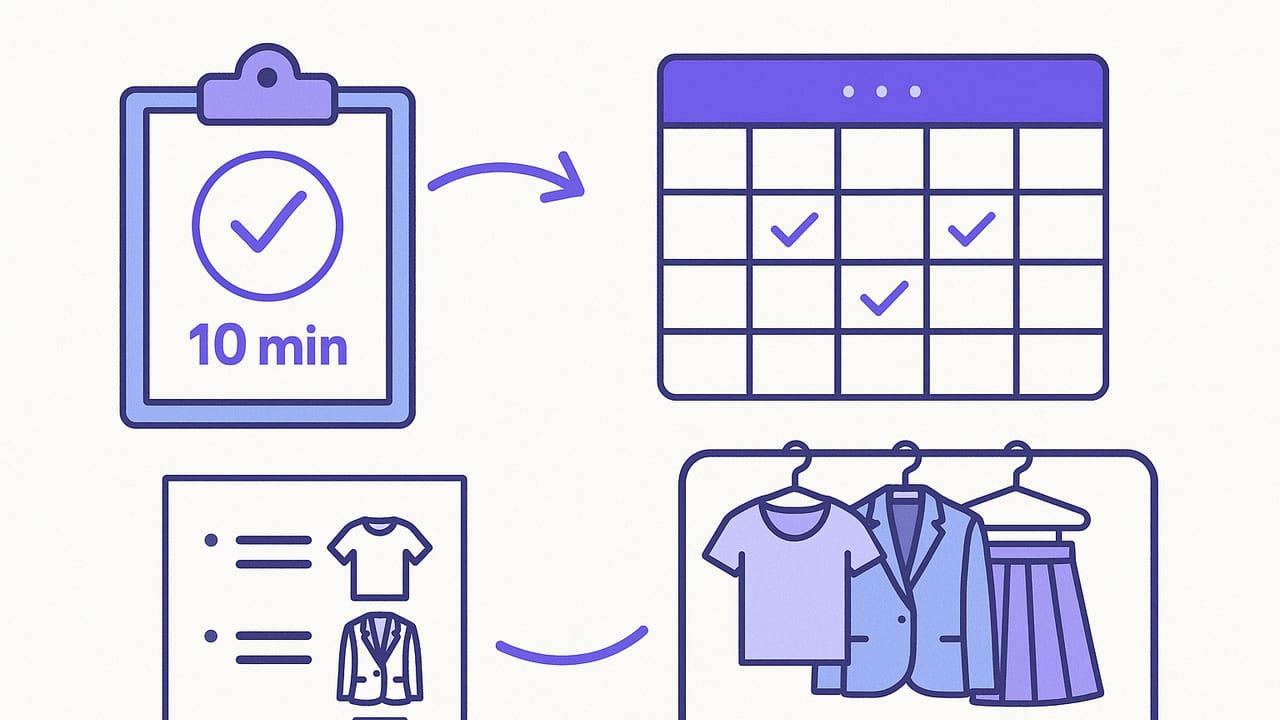
Step 3: Plan the Week in 10 Minutes
Open your calendar and a weather app. For each day, note the highest‑impact factor: meeting, commute, precipitation, or social plan. Then attach a formula. Here’s a sample planner:
| Day | Weather | Activities | Outfit Formula | Items / Notes |
|---|---|---|---|---|
| Mon | 60°F, light rain | Office, stand‑up, commute | smart casual | oxford + chinos + loafers + trench; umbrella |
| Tue | 65°F, cloudy | WFH, video call | WFH casual | knit polo + jogger + clean sneaker; tidy top half |
| Wed | 58°F, windy | Client meeting | business casual | fine knit + charcoal trouser + blazer + derby |
| Thu | 70°F, sunny | Office + dinner | smart casual | striped button‑down + dark denim + loafers |
| Fri | 72°F, sunny | Casual Friday | weekend | tee + overshirt + straight jean + retro runner |
| Sat | 68°F, clear | Brunch, errands | weekend | navy knit + beige chino + white sneaker |
| Sun | 66°F, light breeze | Park, low key | WFH casual | white tee + jogger + slip‑on |
Place the chosen pieces on a single rail or section of your closet so you’re not hunting on busy mornings.
Smart Constraints That Make Decisions Easier
- Weather first: Rain means water‑resistant shoes and outerwear; wind means secure layers.
- Calendar intensity: The most visible meeting of the day sets the dress code.
- Laundry cycle: Assign breathable, easy‑wash pieces earlier in the week; heavier items later.
- Comfort baseline: If you’ll walk 8k steps, prioritize shoes accordingly.
- Layer logic: Base (breathable) + mid (texture) + shell (weatherproof) keeps you ready for swings.
Pre‑Pack Your “Uniforms”
A uniform is a formula you love so much you can wear it on autopilot. Build 2–3 uniforms across settings:
- Office uniform: knit polo + pleated trouser + loafers
- Creative uniform: boxy tee + dark denim + chore jacket + sneaker
- Weekend uniform: tee + lightweight overshirt + chino + suede sneaker
Uniforms reduce decision fatigue and serve as a safety net when plans change.
Tag Your Closet for Faster Planning
Whether you use a notes app or a digital wardrobe, tags help you filter by weather, dress code, color, and fit. Here’s a simple tagging schema you can copy:
{
  "item": "Navy Knit Polo",
  "category": ["top", "knit"],
  "color": "navy",
  "fit": "regular",
  "season": ["spring", "fall", "summer"],
  "dress_code": ["smart casual", "business casual"],
  "weather": ["mild", "windy"],
  "care": "machine wash cold",
  "pairs_with": ["beige chino", "charcoal trouser", "dark denim"],
  "notes": "works on video calls; layer under blazer"
}
Apply the same fields to bottoms, shoes, and layers. Your weekly plan becomes a quick filter rather than a hunt.
Quick Fit Checks That Prevent Last‑Minute Stress
Before you finalize the weekly rail:
- Try the shoes you’ll walk in the most—comfort is non‑negotiable.
- Check the hem with the intended shoes to avoid awkward lengths.
- Do a mirror glance for each silhouette—no need to try everything if formulas repeat.
The 60‑Second Morning Routine
Planning ahead makes mornings fast. When you wake up:
- Confirm weather and precipitation window.
- Check calendar for any added meetings or plans.
- Dress from the rail. If something changed, do a 5‑second swap:
- Swap shoes first (most impact, least effort).
- Swap outer layer second (blazer to jacket, trench to shell).
- Swap top third (tee to knit, knit to shirt).
Only rework the bottom if necessary. Keep swaps minimal to protect momentum.
Seasonal Rotation and Laundry Rhythm
Planning gets easier when your closet only shows current options. Each season:
- Store off‑season pieces out of sight.
- Refresh your 3×3 palette grid with seasonal textures (linen, flannel, cord).
- Audit shoes for weatherproofing and sole condition.
Align laundry with planning: schedule washes the day before your 10‑minute weekly session so everything you love is available.
Troubleshooting: Common Planning Roadblocks
- “I don’t have enough variety.” Add one accent layer or shoe that works across three formulas.
- “My outfits look good but feel off.” Reassess silhouette balance: pair relaxed with tailored, structured with soft.
- “Weather keeps changing.” Use modular layers: base + light mid + packable shell; keep an umbrella at work.
- “I forget accessories.” Pre‑pack a tray: watch, belt, sunglasses, minimal jewelry.
- “My plan falls apart by Wednesday.” Set a 3‑minute midweek reset to re‑hang, spot clean, and swap Thursday/Friday if needed.
Mini Guide: Building a Capsule That Plans Itself
A small, high‑cohesion wardrobe makes it easy to plan daily outfits:
- Start with 10: 3 tops, 3 bottoms, 2 layers, 2 shoes (all mix‑and‑match).
- Add function: 1 weatherproof layer, 1 dressy shoe.
- Introduce texture: one knit, one suede/leather, one pattern.
- Protect the palette: every new piece must pair with 3 existing items.
When the capsule is tight, formulas happen almost automatically.
Printable Checklist: The 10‑Minute Weekly Plan
- Check weather highs/lows and precipitation for 7 days.
- Mark your highest‑stakes event each day.
- Assign one outfit formula per day.
- Pull items to a weekly rail or shelf.
- Pre‑check shoes and layers for comfort and fit.
- Prep accessories in a tray.
- Schedule a 3‑minute midweek reset.
Example: Two Weeks of Plug‑and‑Play Formulas
Rotate these to keep variety without thinking too much:
- Week A: smart casual, WFH casual, business casual, smart casual, weekend, weekend, WFH casual
- Week B: business casual, smart casual, WFH casual, evening, smart casual, weekend, rest day athleisure
Keep silhouettes consistent; vary color, texture, or one statement piece.
Why This System Makes Planning Daily Outfits Easy
- Constraints drive creativity: limited palette and formulas reduce chaos.
- Front‑load decisions: 10 minutes once saves 10 minutes every morning.
- Modularity: small swaps adapt to weather and surprises.
- Repeatability: weekly rhythm forms a habit you’ll actually keep.
Tools That Make It Even Easier
If you prefer a digital workflow, a smart closet app can help you photograph items, tag by weather and dress code, and preview looks without changing. For iPhone users, Outfit Maker offers AI try‑ons and a digital wardrobe so you can simulate combinations, save weekly plans, and share outfit ideas with friends.
Final Takeaway
Learning how to plan daily outfits easily is about building a simple system you trust: define a palette and silhouettes, use a few reliable formulas, and run a quick weekly planning session. When your closet is organized around function and cohesion, you’ll spend less time deciding—and more time wearing outfits that feel like you, every day.