If you’ve ever stared at a full closet and felt like you have “nothing to wear,” the issue usually isn’t quantity—it’s combinability. The good news: you can learn to mix and match outfits with my wardrobe (and yours) by using a simple structure: categorize, tag, build formulas, and then create an outfit matrix you can reuse.
This guide walks you through a practical, low-stress method to get more outfits from what you already own—without becoming a fashion expert or buying a whole new capsule wardrobe.
Why mixing and matching feels hard (even with lots of clothes)
Most wardrobes grow item-by-item. You buy a great top, a fun jacket, shoes for an event—each piece works in isolation, but not necessarily together. Mixing and matching gets difficult when:
- Too many “statement” pieces compete with each other.
- Color families don’t align (warm vs cool, muted vs saturated).
- Silhouettes clash (oversized top + wide pants + bulky shoes).
- Occasion gaps exist (work tops but no work-appropriate bottoms).
The solution is to create a system that makes your wardrobe more “modular,” like building blocks.
Step 1: Do a fast wardrobe inventory (15 minutes)
You don’t need to document everything to start. Begin with a “core set” you actually wear. Pull 5–10 items from each group:
- Tops: tees, blouses, sweaters
- Bottoms: jeans, trousers, skirts
- One-pieces: dresses, jumpsuits
- Layers: blazer, cardigan, jacket
- Shoes: casual, dressy, weather-proof
Rule: If you haven’t worn it in a year and it isn’t for a specific need (formalwear, seasonal gear), it doesn’t belong in the “mix-and-match” set yet.
Step 2: Tag each item with “mixing labels”
Tags make it easier to create outfits quickly. You can do this in a notes app, spreadsheet, or digital wardrobe tool. Use labels that reflect real-life outfit decisions:
- Formality: casual / smart casual / business / formal
- Temperature: hot / mild / cold (or layering-friendly)
- Color family: warm / cool / neutral; plus main color
- Silhouette: fitted / straight / oversized / cropped
- “Hero” vs “support”: statement piece or basic anchor
Mix-and-match wardrobes are built on anchors. The more “support” pieces you have, the easier it is to wear your “hero” pieces repeatedly without feeling repetitive.
A quick tagging template (copy/paste)
Item:
Category: top/bottom/layer/shoe/one-piece
Formality: casual/smart casual/business/formal
Temp: hot/mild/cold
Color:
Color family: warm/cool/neutral
Silhouette: fitted/straight/oversized/cropped
Role: hero/support
Notes: fabric, comfort, fit quirks
Step 3: Use outfit formulas (not random creativity)
Outfit formulas are repeatable “recipes.” They reduce decision fatigue and make it easier to mix and match outfits with my wardrobe because you’re not reinventing the wheel every morning.
5 reliable formulas that work for most wardrobes
- Balanced basics: simple top + structured bottom + clean shoe
- Third-piece upgrade: tee + jeans + blazer/jacket
- Monochrome column: same-color top & bottom + contrasting layer
- High-low mix: dressy top + casual bottom (or vice versa)
- One-piece + layer: dress/jumpsuit + outer layer + intentional shoe
Tip: If an outfit feels “off,” it’s usually missing one of these: a third piece (layer), a defined waistline, or a cleaner shoe choice.
Step 4: Build an outfit matrix (the fastest way to generate combinations)
An outfit matrix is a simple table that shows which tops work with which bottoms. This is where mixing and matching becomes obvious—and where you’ll discover which item is “hard to style.”
Outfit matrix example
| Top \ Bottom | Dark Jeans | Black Trousers | Midi Skirt |
|---|---|---|---|
| White Tee | ✅ Casual | ✅ Smart casual (add blazer) | ✅ Weekend (add sneaker) |
| Silk Blouse | ✅ High-low | ✅ Business | ✅ Dinner (add heel) |
| Chunky Sweater | ✅ Cozy | ⚠️ Watch bulk (tuck/half-tuck) | ✅ Proportion win (add boot) |
Mark each cell as:
- ✅ Works (you’d wear it tomorrow)
- ⚠️ Needs styling (specific shoe, tuck, belt, layer)
- ❌ Doesn’t work (color clash, silhouette clash, wrong vibe)
This table becomes your personal outfit cheat sheet.
Step 5: Use a simple color strategy that guarantees cohesion
You don’t need to master color theory. You need a few repeatable rules:
Rule A: Build around a neutral anchor
Pick 2–3 neutrals you love and repeat them across categories (tops, bottoms, shoes, layers): black, navy, cream, gray, denim, olive, or brown.
Rule B: Apply the “60–30–10” balance
- 60% base (dominant neutral)
- 30% secondary (another neutral or muted color)
- 10% accent (scarf, bag, lipstick, jewelry, bold shoe)
Rule C: Match saturation, not just color
Muted items (dusty blue, taupe, charcoal) look best together. Bright items (true red, cobalt, crisp white) look best together. If an outfit feels strange, the saturation level might be mismatched.
Step 6: Make silhouettes “click” with a proportion check
When you mix and match, you’re really mixing shapes. Use these quick proportion rules:
- Volume + volume needs structure: oversized top + wide pants works best with a defined waist (tuck, belt) or sleek shoe.
- Fitted + loose is the easiest formula: fitted top + wide leg, or oversized sweater + slim/straight bottom.
- Use the shoe to finish the silhouette: chunky shoe adds weight; sleek shoe elongates.
Step 7: Create a weekly “outfit loop” (so you don’t start from zero)
Instead of planning endlessly, create a loop you can repeat and refresh:
- Pick 3 bottoms you’ll wear this week (e.g., jeans, trousers, skirt).
- Pick 6 tops that work with at least 2 of those bottoms.
- Pick 2 layers (one casual, one polished).
- Pick 2 shoes (comfort + elevated).
- Pre-make 5 outfits using your matrix and formulas.
Now you have variety, but everything still mixes.
Practical example: turn 12 items into 30+ outfits
Let’s say your “core set” is:
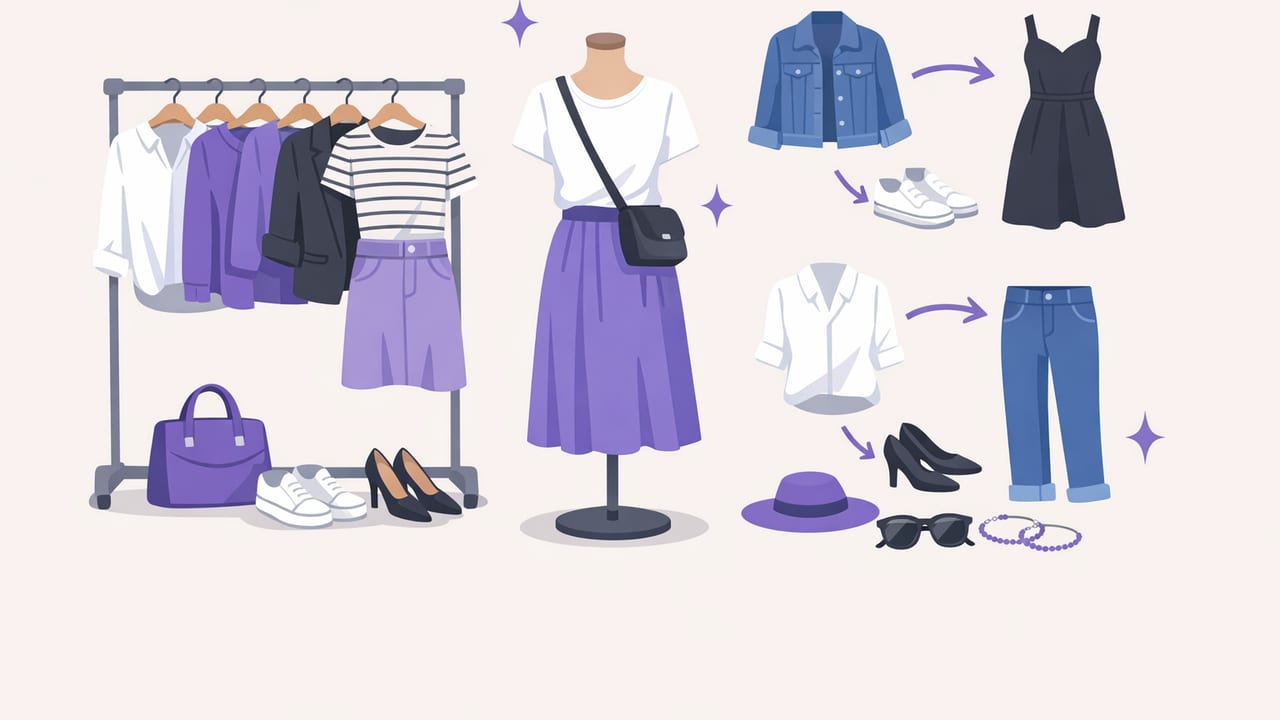
- 3 bottoms: dark jeans, black trousers, midi skirt
- 5 tops: white tee, striped tee, knit top, blouse, sweater
- 2 layers: denim jacket, blazer
- 2 shoes: white sneakers, ankle boots
Even without dresses or accessories, you can build:
- Base combinations: 3 bottoms × 5 tops = 15
- Add layers: 15 × (no layer + 2 layers) ≈ 45 looks
- Reality filter: remove duplicates and “too warm/cold” outfits → still 25–35 wearable outfits
This is why a small, compatible set beats a large, disconnected wardrobe when your goal is to mix and match outfits quickly.
Troubleshooting: what to do when pieces don’t mix
1) Identify “orphan items”
If an item only works with one other item, it’s an orphan. Your options:
- Style fix: try a different shoe, tuck, belt, or layer.
- Bridge piece: add one basic that connects it (e.g., neutral tank, simple knit, classic trouser).
- Quarantine: move it out of the core set until you have the right supporting pieces.
2) Reduce duplicate “heroes”
If you have five bold prints but only one neutral bottom, mixing will always feel hard. Increase basics first; they multiply outfits.
3) Fix fit issues before buying more
Mixing and matching fails when fit is uncomfortable. Tailoring a waistband or hemming trousers often creates more new outfits than a new purchase.
How to organize this system (without becoming overwhelmed)
Choose the lightest tool that you’ll actually use:
- Pen + paper: list your core items and write 10 formulas you like.
- Notes app: keep an “Outfit Matrix” note and a saved list of go-to combos.
- Spreadsheet: best if you enjoy structure and want tags + filters.
- Photo album: screenshot outfits you liked and create an “Outfit Wins” folder.
If you prefer visual planning and virtual try-ons, an iOS wardrobe planner like Outfit Maker can help you catalog pieces and test combinations from photos—useful when you’re refining your matrix.
Summary: your repeatable mix-and-match checklist
- Start with a core set of items you already wear.
- Tag items by formality, temperature, color family, and silhouette.
- Rely on outfit formulas instead of improvising daily.
- Build an outfit matrix to see what truly works together.
- Use neutral anchors and consistent saturation for easy color harmony.
- Plan weekly using a small loop of bottoms, tops, layers, and shoes.
Once you have this structure, you’ll spend less time deciding what to wear—and get far more value out of every piece you already own.