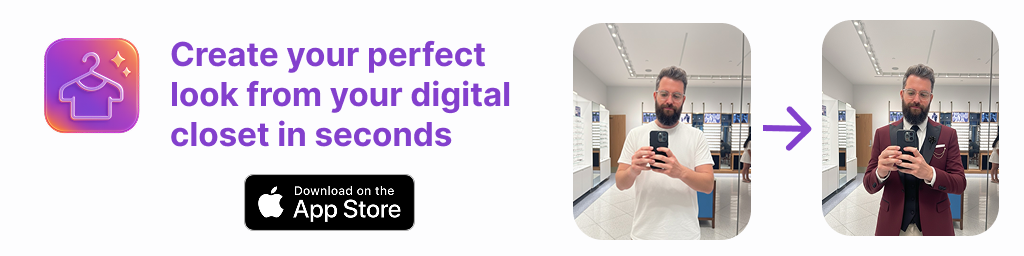
A digital wardrobe planner should do more than store photos of your clothes. Done well, it becomes a practical system for choosing outfits faster, repeating your best combinations more often, and avoiding “nothing to wear” moments—without buying more.
This guide explains a proven setup that works with most closet apps (including those that offer virtual try-on and an AI outfit generator): a simple tagging structure, a few decision rules, and a lightweight weekly routine. The goal is to make outfit planning feel automatic, not like a second job.
Why most digital wardrobes don’t save time (and how to fix it)
Many people start strong: they photograph items, upload them, and then… stop using the app. The common reasons are predictable:
- Too many tags (or none at all), so searching becomes frustrating.
- No outfit logic: the app shows combinations, but you don’t have rules to quickly filter what works.
- Unrealistic expectations: trying to catalog everything perfectly before getting value.
- Not tied to real life: outfits aren’t connected to your schedule, climate, or comfort needs.
The fix is to treat your digital wardrobe planner like a small database: limited fields, consistent values, and a repeatable workflow that improves over time.
The “5-Tag” foundation (minimal, searchable, scalable)
If you only tag five things consistently, you can build outfits quickly and still keep your closet organized. Here’s the recommended baseline:
- Category (e.g., jeans, blazer, sneakers)
- Color family (e.g., black, cream, navy, green)
- Season/temperature (e.g., hot, mild, cold, layered)
- Formality (e.g., casual, smart casual, business, event)
- Comfort level (e.g., relaxed, structured, sensitive-day)
What to avoid tagging at first
Skip overly granular tags until you actually need them. Examples: exact fabric content for every item, micro-trends, or dozens of style aesthetics. You can always add detail later, but a digital wardrobe planner fails when it becomes inconsistent.
Build outfit “rules” that your planner can follow
Tags help you find items; rules help you decide. Write a few personal outfit rules and use them when filtering or generating looks with an AI outfit generator.
Starter outfit rules (edit to fit your life)
- Work rule: “If it’s business, add one structured layer (blazer, coat, tailored overshirt).”
- Weather rule: “Below 10°C/50°F means socks + closed shoes + an outer layer.”
- Color rule: “Max 3 color families per outfit, one of them neutral.”
- Comfort rule: “If I’ll be walking >30 minutes, shoes must be tagged ‘walkable.’”
- Silhouette rule: “One fitted + one relaxed piece (avoid tight+tight).”
Tip: The best rules are the ones you already follow unconsciously. Writing them down makes your digital wardrobe planner feel smarter instantly.
A practical tagging schema (with an example you can copy)
Consistency matters more than creativity. Use controlled vocabulary (the same words every time), especially for temperature and formality. If you want a clean structure, model your tags like this:
{
  "item": "Black straight-leg jeans",
  "category": "jeans",
  "color_family": ["black"],
  "temperature": ["mild", "cold", "layered"],
  "formality": "smart casual",
  "comfort": "relaxed",
  "notes": "Works with ankle boots and loafers"
}
You don’t need to store your wardrobe in a spreadsheet to benefit from this—many apps let you apply the same concepts using built-in fields, tags, and notes.
How to photograph and upload items efficiently (without perfectionism)
Your digital wardrobe planner becomes useful once you can recognize items and compare them. You don’t need studio lighting.
- Batch by category: tops first, then bottoms, then shoes, then outerwear.
- Use the same background when possible (a blank wall helps).
- Capture true color: stand near a window; avoid yellow indoor lighting.
- Include key details: neckline, sleeve shape, rise/length for bottoms.
- Stop at 30–40 core items if you’re overwhelmed. Add the rest later.
The weekly outfit prep routine (10 minutes, no overplanning)
This is the habit that turns a closet database into a daily decision tool. Once a week, do a fast planning pass using your schedule and forecast.
Step-by-step weekly workflow
- Check your calendar: identify 2–3 situations (office day, dinner, travel, gym, event).
- Check weather: note temperature range and rain/wind.
- Choose 3 “anchor” items: one bottom, one shoe, one layer you can repeat.
- Generate or assemble 5 outfits: use your tags + rules (and virtual try-on if available).
- Save them as a set: label it “Week of ___” or “Workweek Core.”
- Pre-empt friction: add notes like “needs ironing,” “requires strapless bra,” “only with thin socks.”
Even if you only wear 2 of the planned outfits, you’ve reduced mental load for the whole week—and you’ve created data about what you actually choose.
Use a “re-wear index” to find your best outfits
Outfit planning gets dramatically easier when you stop reinventing looks from scratch. Add a lightweight scoring habit inside your digital wardrobe planner:
- After wearing: rate the outfit 1–5 for comfort and confidence.
- Save winners: anything rated 4–5 goes into a “Proven” collection.
- Retire losers: anything rated 1–2 gets a note explaining why (fit, itchy, wrong temperature).
What this improves over time
- Better AI outfit generator results (because your favorites become clearer).
- Smarter shopping (you know what gaps are real vs. imagined).
- Fewer “almost” items taking up space in your closet and your app.
Digital wardrobe planner features that matter (and what to ignore)
Apps vary, but the same core features tend to provide the most day-to-day value:
| Feature | Why it matters | Quick test |
|---|---|---|
| Fast item entry | Reduces friction; you’ll actually keep it updated | Can you add an item in under 30 seconds? |
| Reliable tagging/filtering | Makes outfits searchable by weather, formality, color | Can you filter “cold + business + black shoes”? |
| Outfit saving + collections | Lets you reuse proven looks without thinking | Can you store “5 work outfits” as a set? |
| Virtual try-on | Helps you compare silhouettes and combinations quickly | Can you visualize outfits without changing clothes? |
| AI outfit generator | Speeds up ideas when you’re stuck | Can it follow your tags/rules, not just random pairings? |
What to ignore early on: overly complex analytics, endless style quizzes, or anything that requires perfect data before you get benefit.
Common mistakes (and the simplest fixes)
Mistake 1: Cataloging everything before using it
Fix: Start with the items you wear weekly. A partial wardrobe that you use beats a perfect wardrobe you avoid.
Mistake 2: Treating “formality” as one-size-fits-all
Fix: Define formality based on your life. “Business” for one person might be “smart casual” for another.
Mistake 3: Forgetting real constraints (shoes, bras, outerwear)
Fix: Tag constraints as comfort notes. These details are often why outfits fail in practice.
Mistake 4: Using AI without guardrails
Fix: Generate options only after filtering by temperature + formality + comfort. You’ll get fewer but better outfit suggestions.
Privacy and data: what to think about
A digital wardrobe planner involves photos of your clothes and sometimes photos of you. Before uploading, it’s worth checking:
- On-device vs. cloud processing: where images are stored and analyzed.
- Account controls: can you export or delete your data easily?
- Sharing defaults: are outfits private unless you choose to share?
These considerations don’t need to slow you down, but they should inform which app you trust for long-term wardrobe tracking.
A simple plan you can start today
- Upload 30 core items (tops, bottoms, shoes, a couple of layers).
- Apply the 5 tags: category, color family, temperature, formality, comfort.
- Write 3 outfit rules you already live by.
- Save 10 outfits: 5 “work/weekday,” 5 “weekend/social.”
- Do a 10-minute weekly outfit prep using your schedule and forecast.
Once this is in place, your digital wardrobe planner becomes a repeatable decision system—not just a place to store images.
If you’re looking for an iOS option that combines wardrobe planning with virtual try-on and AI outfit generation, apps like Outfit Maker follow the same principles described here—so the method transfers no matter which tool you choose.