You don’t need a new shopping haul to look new. The fastest style gains often come from learning how to create outfits with existing clothes you already own. With a few repeatable formulas, smart tagging, and a lightweight weekly routine, you’ll unlock dozens of fresh combinations—without spending a cent. This guide shows you the exact steps and tools you can use today.
Why Start With What You Own
- Save time and money: Styling the pieces you already love beats endlessly searching for something “perfect.”
- Define your signature: Recombining your staples highlights what truly suits you—fit, colors, and proportions.
- Reduce clutter: When everything has more than one role, fewer items sit idle.
- Build confidence: A reliable system lowers morning decision fatigue and last-minute outfit panic.
Step-by-Step: Create Outfits With Existing Clothes
1) Do a 30-minute closet audit
Pull out 15–25 items you wear most, plus 5–10 you rarely wear. This small sample is enough to learn what works. For each piece:
- Fit check: Rate comfort and silhouette (slim, straight, relaxed).
- Condition: Note repairs or cleaning needed.
- Role: Everyday, office, occasion, active, lounge.
- Pairing ideas: Jot 1–2 items it clearly matches.
Set aside anything that doesn’t fit your current life or size. You can store, tailor, or donate later.
2) Tag for mix-and-match power
A simple tag system turns your wardrobe into a searchable library. Use these five tags for each item:
- Category: top, bottom, dress, outerwear, shoe.
- Color: primary color and whether it’s neutral or accent.
- Fit/Silhouette: slim, straight, oversized, cropped, high-rise, wide-leg, etc.
- Dress code: casual, smart-casual, business-casual, formal.
- Season/Temperature: hot, mild, cool, cold; rain/snow friendly if relevant.
If you like a structured approach, here’s a compact tagging template you can copy into notes or a spreadsheet:
{
  "item": "white oxford shirt",
  "category": "top",
  "color": { "name": "white", "type": "neutral" },
  "fit": ["straight", "regular"],
  "dress_code": ["smart-casual", "business-casual"],
  "season": ["mild", "cool"]
}
Keep it lightweight: a minute per item is enough. You’ll refer to these tags when building formulas and matrices.
3) Use outfit formulas you can repeat
Formulas convert your closet into building blocks. Start with three reliable patterns:
- Monochrome base + contrast layer: Example: black tee + black jeans + camel trench + white sneakers.
- Statement + two neutrals: One accent or patterned item + two quiet pieces. Example: floral blouse + navy trousers + beige loafers.
- Balanced silhouettes: Volume on top, sleek on bottom—or vice versa. Example: oversized sweater + slim jeans + ankle boots.
These formulas ensure contrast, cohesion, and proportion—key ingredients for outfits that look intentional.
Build an Outfit Matrix From What You Own
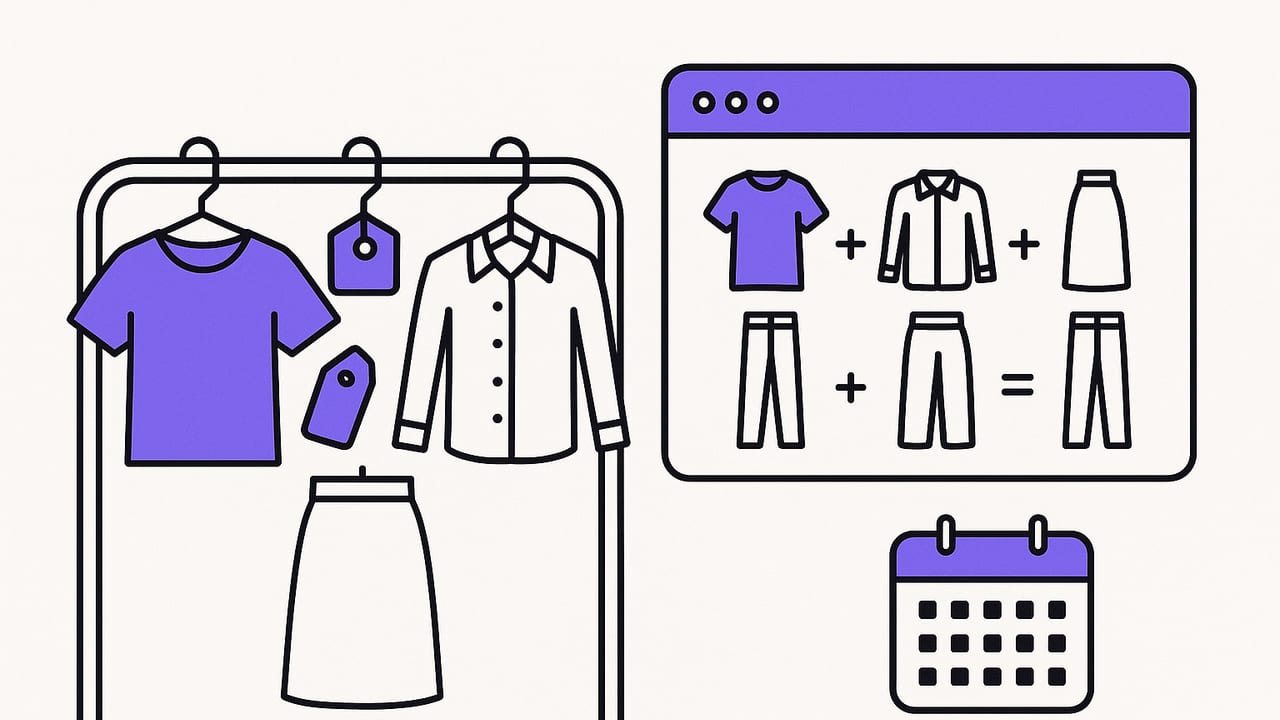
An outfit matrix is a simple table that reveals your best pairings at a glance. Put tops as rows and bottoms as columns. Mark combinations that work, then prioritize those for the week.
| Top \ Bottom | Black jeans | Tan chinos | Dark denim | Wide-leg trouser |
|---|---|---|---|---|
| White oxford | ✓ | ✓ | ✓ | ✓ |
| Navy tee | ✓ | ✓ | ✓ | — |
| Striped knit | ✓ | — | ✓ | ✓ |
| Silk blouse (emerald) | ✓ | ✓ | ✓ | — |
Fill your matrix fast by applying the formulas: try your monochrome base, your statement + two neutrals, and your silhouette balance to each pairing. Add one more column for shoes and note which style (sneaker, loafer, boot, heel) suits each look.
Color Pairings You Can Trust
Color is where many outfits fall apart. Keep it simple with a neutral base and selective accents.
| Neutral Base | Accents That Pop |
|---|---|
| Black / charcoal | White, cobalt, emerald, metallics |
| Navy | Tan, burgundy, blush, yellow-gold |
| Beige / camel | White, forest green, terracotta, denim |
| Grey | Black, pastel pink, teal, oxblood |
| White / cream | Navy, olive, rust, silver |
Rule of thumb: two neutrals + one accent is nearly foolproof. If you want two accents, keep them in the same temperature family (both warm or both cool) and vary saturation.
Proportion Cheats That Instantly Improve Outfits
- The tuck trick: Front-tuck or full-tuck to raise your visual waist and lengthen the leg line.
- Show the ankle: Cropped pants or a slight roll above the ankle pairs best with low-profile shoes.
- Structured layer: A blazer, denim jacket, or trench adds angles that sharpen soft knits and tees.
- One focal point: If your top is voluminous, keep the shoe clean and streamlined.
- Belts as borders: Use a belt to break a long column of color when needed; skip it for a sleeker silhouette.
When in doubt: one relaxed piece, one tailored piece, one clean shoe.
Mini Capsule: 12 Items, 30+ Looks
Here’s a small example that shows how far a few pieces can go when you create outfits with existing clothes. You likely own versions of these already.
| Item | Type | Notes |
|---|---|---|
| White oxford shirt | Top | Neutral, smart-casual |
| Navy tee | Top | Neutral, casual |
| Striped knit | Top | Neutral pattern |
| Silk blouse (emerald) | Top | Accent, elevated |
| Black jeans | Bottom | Slim, year-round |
| Tan chinos | Bottom | Straight, smart-casual |
| Dark denim | Bottom | Straight, casual |
| Wide-leg trouser | Bottom | Tailored, dressy |
| Denim jacket | Outer | Casual layer |
| Blazer (camel) | Outer | Smart layer |
| White leather sneakers | Shoe | Casual, clean |
| Beige loafers | Shoe | Smart-casual |
Mix using the formulas:
- Navy tee + tan chinos + white sneakers + denim jacket
- White oxford + black jeans + loafers + blazer
- Striped knit + dark denim + white sneakers
- Emerald blouse + wide-leg trouser + loafers + blazer
- White oxford (tucked) + wide-leg trouser + loafers
Continue down your matrix and you’ll quickly cross 30 looks, especially once you rotate accessories (watch, scarf, belt, simple jewelry) and outerwear.
A 10-Minute Weekly Outfit Workflow
- Check the calendar and weather: Note dress codes and temperatures for each day.
- Pick anchors: Choose 2–3 bottoms that fit the forecast; they’re your foundation.
- Apply formulas: For each bottom, pair a top using one formula, then add a layer if needed.
- Lock footwear: Assign shoes by activity: walking days get sneakers; meetings get loafers/boots/heels.
- Batch try-on (optional): Do a quick mirror check and snap photos for reference.
- Stage outfits: Hang each look together or store in labeled stacks so mornings stay calm.
By repeating the workflow weekly, you’ll get faster at spotting what’s missing (e.g., a clean white sneaker, a neutral belt) and what you actually don’t need to buy.
Troubleshooting: Fix What’s Not Working
- “Everything looks flat.” Add texture contrast: denim vs. silk, knit vs. leather. Or introduce a structured layer.
- “Colors clash.” Rebuild with a neutral base first; add one accent only. Use the color table above.
- “Too casual for the office.” Swap in tailored trousers or a blazer. Keep shoes polished and minimal.
- “I feel boxy.” Balance volume. Tuck tops, crop hemlines, or choose slimmer footwear.
- “I’m repeating outfits too often.” Change the layer or shoe; adjust tuck and accessories. It will read as new.
Advanced Tips for More Options
- 3x3 rule: For any upcoming week, choose 3 tops, 3 bottoms, and 1–2 layers. Aim for at least 7 unique combinations.
- Accessory ladder: Start minimal (watch), then add one piece at a time (belt, necklace, scarf). Stop when the outfit gains focus.
- Seasonal swap: Rebuild the matrix when the weather shifts. Replace linens and breathable knits with wool, denim, and heavier cotton—keep the formulas the same.
- Tailoring ROI: Hemming trousers or nipping a blazer waist often multiplies pairings far more than buying a new item.
FAQ
How many items do I need to make this work?
Even 10–12 well-chosen pieces can yield 20–30 looks. Focus on neutral bases and one or two accent items to start.
What if my wardrobe is very colorful?
Treat one color as your “neutral” base (navy, olive, denim can work) and coordinate other hues by keeping saturation similar or pairing with white/black to reset.
How do I handle footwear for mixed activities?
Use a two-shoe weekly plan: one clean sneaker for high-activity days and one smart shoe (loafer/boot/heel) for elevated settings. Plan outfits to match each shoe’s vibe.
How can I track what I’ve already worn?
Snap quick mirror photos and save them in a dedicated album. Tag by dress code or season for rapid retrieval. Over time, you’ll build a personal lookbook.
Putting It All Together
To consistently create outfits with existing clothes, think in frameworks instead of one-off looks: tag your items, apply simple formulas, test combinations in a matrix, and plan your week in ten minutes. The more you reuse this system, the more combinations you’ll discover, and the more confident you’ll feel getting dressed.
If you like to visualize combinations or try looks virtually from your iPhone, the Outfit Maker app can streamline this process by cataloging your wardrobe and previewing how pieces pair—so you can plan faster and wear more of what you own.