Ever stood in front of a full closet and still felt like nothing goes together? The missing piece usually isn’t more clothes—it’s a color plan. Understanding color theory for outfits helps you match clothes faster, build a cohesive wardrobe, and make every purchase work harder. Whether you’re creating a capsule wardrobe, planning a trip, or prepping for the week, a color-savvy approach saves time and amplifies your style.
This guide translates the color wheel into real-life dressing. You’ll learn simple color combinations, formulas you can apply daily, and a step-by-step method to build a wardrobe color palette that fits your lifestyle.
Why Color Theory Matters in Your Wardrobe
- Consistency: A defined palette ensures new pieces blend with what you own.
- Speed: Fewer mismatches means you can assemble outfits in minutes.
- Versatility: Mix-and-match becomes effortless when colors relate.
- Cost savings: You buy less and wear more because every item works in multiple outfits.
Style isn’t about how much you own—it’s about how well your pieces relate. Color is the “glue” that turns clothes into outfits.
The Color Wheel for Outfits, Explained Simply
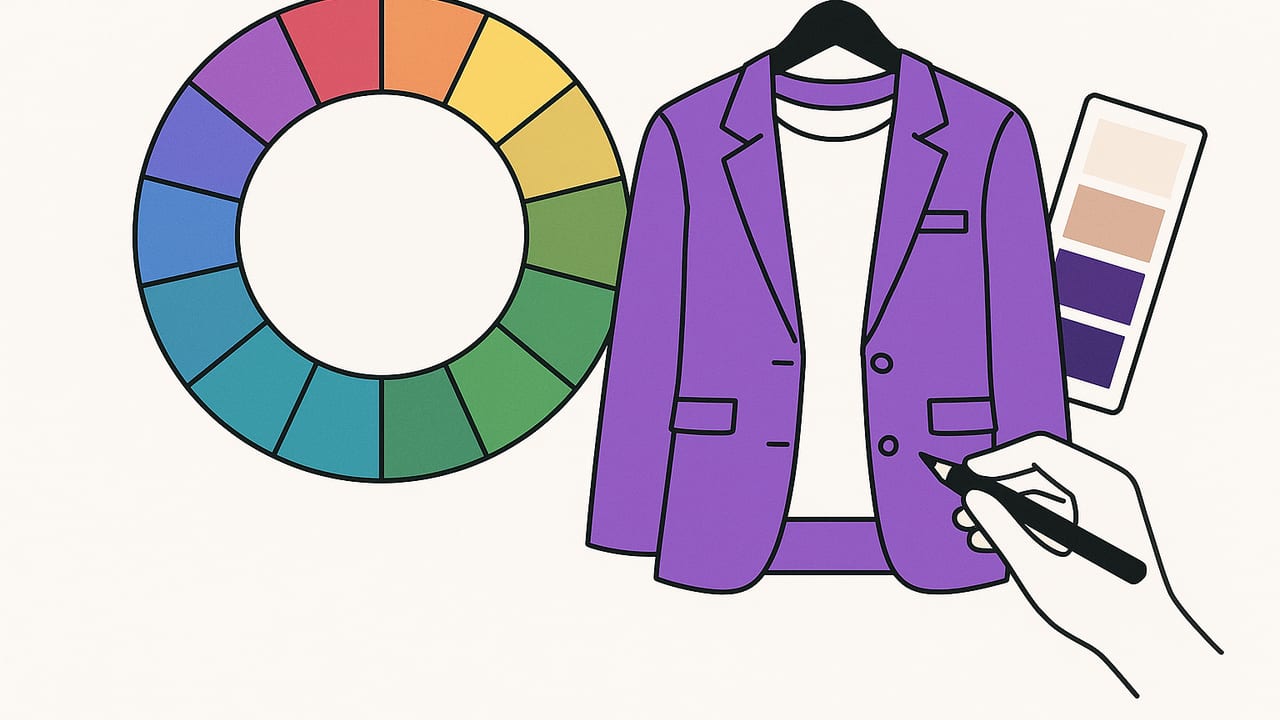
Color theory maps relationships between hues. You don’t need an art degree—just a few pairings that consistently look good. Below is a practical translation of color harmonies into everyday outfits.
| Harmony | How It Looks | Outfit Ideas |
|---|---|---|
| Monochromatic | Different tints/shades of one color | Navy blazer + indigo jeans + light blue shirt; Olive sweater + sage chinos + tan boots |
| Analogous | Neighbors on the color wheel | Forest green jacket + olive pants + mustard tee; Burgundy coat + rust sweater + beige trousers |
| Complementary | Opposites on the wheel | Blue denim + orange/caramel sweater; Purple blouse + yellow-gold accessories |
| Split-Complementary | One color + the two neighbors of its opposite | Teal top + rust skirt + mustard bag; Coral dress + forest green earrings + navy shoes |
| Triadic | Three evenly spaced colors | Blue jacket + red tee + yellow sneakers (mute one for balance); Olive pants + navy shirt + marigold scarf |
| Tetradic (Double Complement) | Two complementary pairs | Blue + orange + green + red (keep two dominant, two accents); Plum + sage + mustard + navy |
| Neutral + Accent | Neutrals with one pop color | Black trousers + white shirt + red flats; Gray suit + camel coat + emerald scarf |
In daily life, you’ll rely most on Monochromatic, Analogous, and Neutral + Accent. Use complementary and triadic when you want bolder contrast, and keep the saturation balanced: if your accent is vivid, mute the rest.
Build a Wearable Wardrobe Color Palette
A personal palette creates instant cohesion and makes outfit planning nearly automatic. Follow this framework to design one that suits your lifestyle and existing clothes.
Step 1: Audit What You Already Own
- Lay out your most-worn items and note dominant colors.
- Group into buckets: light neutrals (white, cream), mid neutrals (gray, taupe), dark neutrals (navy, black, espresso), accents (green, red, cobalt, etc.).
- Highlight workhorses (goes with 3+ pieces) versus orphans (goes with none).
Patterns count as colors. A striped navy-and-white tee behaves like both navy and white. A floral with green and pink gives you two accents to pull from.
Step 2: Choose Your Core Neutrals (2–3)
Neutrals make up the backbone of outfits. Pick two or three that appear frequently in your closet and fit your dress code.
- Light neutrals: white, ivory, ecru, light gray
- Mid neutrals: heather gray, camel, taupe, khaki
- Dark neutrals: navy, charcoal, black, chocolate
Tip: If you wear black often, choose navy or charcoal (not both) as your dark companion—it keeps your palette focused.
Step 3: Add 2–3 Accent Colors
Accents create interest in tops, accessories, and outerwear. Choose hues you already reach for and that harmonize with your neutrals.
- Cool-leaning accents: cobalt, emerald, raspberry, violet
- Warm-leaning accents: rust, mustard, coral, olive
- Soft accents: dusty rose, sage, powder blue
Start with two accents and add a third after you’ve tested combinations. A good rule: at least one accent should pair with all your neutrals.
Step 4: Decide on Metals and Denim
- Metals: Pick gold, silver, or mixed as your default. Matching hardware across belts, bags, and jewelry subtly elevates outfits.
- Denim: Treat denim washes like colors: light blue (casual, airy), mid-blue (versatile), dark indigo (polished), black (edgy), ecru (fresh).
Step 5: Pattern Strategy
- Choose patterns that echo your palette: stripes, checks, florals in your neutrals + accents.
- Limit high-contrast patterns if your wardrobe is mostly soft and muted (and vice versa).
- Use patterns as bridges between colors—e.g., a scarf that includes your accent and a neutral ties the outfit together.
How to Match Clothes: Quick Color Formulas
Use these plug-and-play formulas to assemble looks fast. Swap your specific colors as needed.
- Formula 1 (Safe & Sharp): Light neutral top + dark neutral bottom + accent shoe/bag.
- Formula 2 (Analogous Ease): Neutral base + two neighboring accents (e.g., olive jacket + mustard tee over beige trousers).
- Formula 3 (Soft Monochrome): Same color family head-to-toe, varied in depth and texture (e.g., slate shirt + charcoal pants + gray knit).
- Formula 4 (Complement Pop): Neutral outfit + one complementary accent (e.g., navy suit + rust tie).
- Formula 5 (Weekend Triad, Muted): Denim + two low-saturation accents (e.g., faded blue jeans + sage hoodie + marigold cap).
Choosing Colors for Your Undertone (Without Overthinking)
Undertones can guide your best accents, but don’t treat them as rules. Here’s a quick feel-based check:
- Warm undertones: Skin leans golden/peach; gold jewelry flatters. Accents: olive, rust, terracotta, mustard, warm teal.
- Cool undertones: Skin leans pink/rosy; silver jewelry flatters. Accents: cobalt, emerald, magenta, icy pastels, true red.
- Neutral undertones: Both gold and silver look fine; you can wear warm or cool accents if saturation matches your features.
Match intensity to your features. If your hair, eyes, and skin contrast strongly (dark hair, light skin), higher-contrast outfits (black/white, complementary pops) often shine. If your features are softer, low-contrast palettes (cream, taupe, dusty accents) typically harmonize better.
Season-Proof Palettes: Rotate Accents, Keep Neutrals
Instead of rebuilding your wardrobe each season, keep neutrals steady and rotate accents.
- Spring: ivory, taupe, light denim + sage, lilac, coral
- Summer: white, light gray, ecru denim + cobalt, raspberry, seafoam
- Fall: camel, chocolate, indigo + rust, mustard, forest
- Winter: black, charcoal, navy + emerald, burgundy, ice blue
Your accessories do heavy lifting here: scarves, bags, belts, and shoes can “seasonalize” the same core outfits.
Common Color Mistakes—and Easy Fixes
- Mistake: Mixing too many saturated colors at once.
Fix: Limit to one vivid accent; keep the rest neutral or muted. - Mistake: Clashing undertones (e.g., cool gray with very warm mustard) in the same high-contrast outfit.
Fix: Add a bridge color or choose a cooler mustard (more gold, less orange). - Mistake: Only buying black as a default.
Fix: Try navy or charcoal for equal versatility and more dimension. - Mistake: Neglecting texture and value (light vs dark).
Fix: If colors match but look flat, vary textures (knit, leather, silk) and lightness (light top, dark bottom). - Mistake: Orphan accents that match nothing.
Fix: Add two connectors: a scarf or belt containing that accent, and shoes/bag in a similar tone. - Mistake: Pattern overload.
Fix: Anchor with solids; keep patterns within your palette and vary scale (one bold, one subtle).
Organizing by Color: Closet Setup That Speeds Up Dressing
A color-aware closet is easier to use. Try this simple structure:
- Group by category (outerwear, knits, shirts, pants, dresses).
- Within each category, arrange by color from light to dark neutrals, then accents.
- Tag outfits visually by placing frequently paired items next to each other or using outfit dividers.
- Keep a small “palette rail” with your current season’s accents visible so you reach for them first.
Color Planning for Special Scenarios
Work Capsule
- Choose one dark neutral suit color (navy or charcoal) and build shirts/knits in analogous hues (light blue, slate, teal).
- Use restrained accents in ties, scarves, or jewelry: burgundy, forest, or cobalt.
Travel Capsule
- Pick 2 neutrals + 2 accents that all pair: e.g., navy, beige + rust, teal.
- Favor solids and one multi-color scarf that includes both accents to multiply combinations.
Event Dressing
- Start with the color temperature of the event (cool black tie vs. warm garden party).
- Match metal to outfit temperature (silver with cool, gold with warm) for cohesive shine.
How Digital Wardrobes Make Color Coordination Easier
Color planning gets simpler when you can see everything at a glance. A digital wardrobe app lets you photograph clothing, tag colors, and filter by hue so you can:
- Test palettes visually before buying new items.
- Create mix-and-match grids to verify that accents work across your neutrals.
- Save outfit formulas and clone them in different colorways.
- Use virtual try-on to preview bolder combinations without changing.
Some apps include AI outfit suggestions that automatically generate color-harmonized looks based on your closet tags and preferences. That’s ideal when you want fresh combinations within your established palette.
Your Action Plan: Color That Works Harder
- Audit your closet and list your top 2–3 neutrals and 2 accents you already wear.
- Pick one color harmony to practice this week (monochrome or neutral + accent).
- Choose a hero accessory (scarf, belt, bag) that carries your accent through multiple outfits.
- Photograph outfits that felt great and note the formula (e.g., light neutral + dark neutral + emerald).
As you repeat these steps, your wardrobe naturally becomes more cohesive, your outfits feel intentional, and getting dressed turns into a quick, creative routine.
If you’d like to plan outfits with an AI outfit generator, catalog your closet by color, and try on combinations virtually on iOS, consider Outfit Maker.