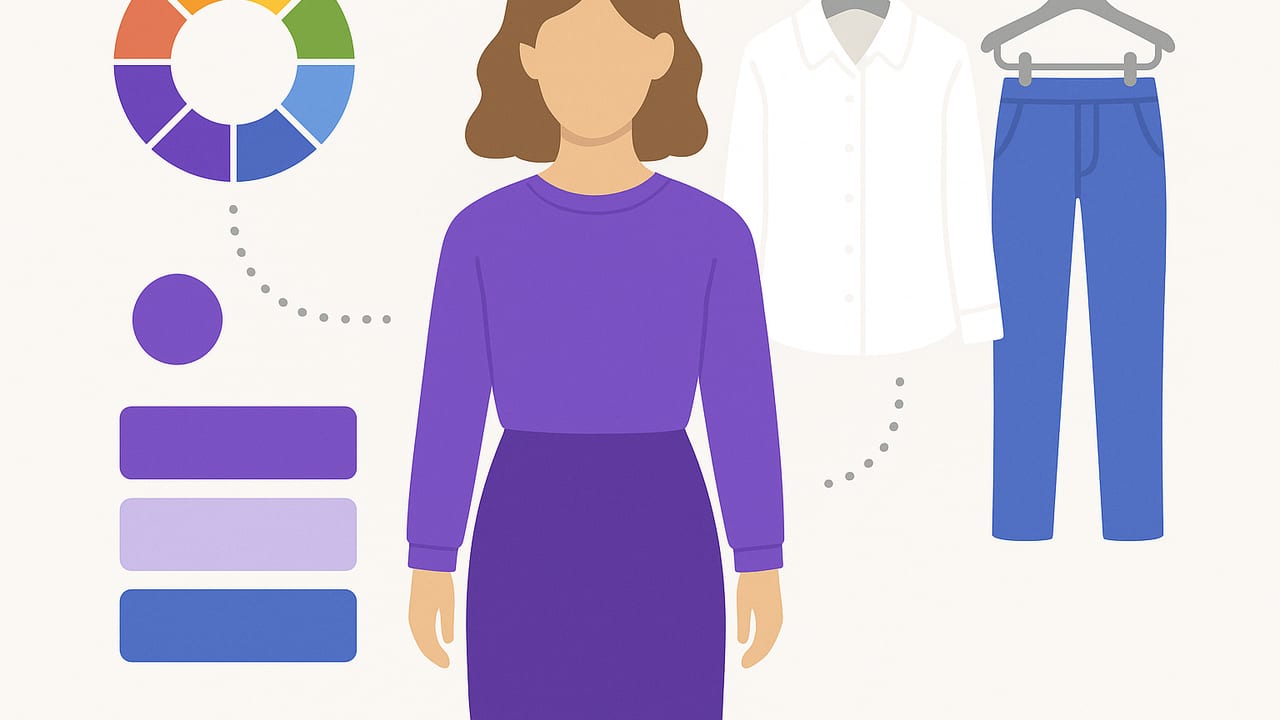
If you’ve ever stared at your closet thinking, “I can’t make anything go together,” this guide is for you. Color is the quickest way to unlock more outfits from what you already own. In this practical, step-by-step playbook, you’ll learn clear rules for color matching looks from my clothes, build a personal palette from your closet, and use simple workflows to try combinations before you wear them.
“Color harmony isn’t about memorizing rules; it’s about learning a few patterns so you can remix what you own with confidence.”
Color foundations: the harmonies that always work
Color theory sounds technical, but the everyday version is simple. Most great outfits rely on a few harmony types. Use these as reliable templates when you’re stuck.
| Harmony | What it looks like | Easy outfit example |
|---|---|---|
| Neutral base | Black, white, gray, navy, beige, tan | White tee + navy trousers + tan loafers |
| Monochromatic | One color, varied shades | Light blue shirt + medium blue jeans + navy jacket |
| Analogous | Neighbors on the color wheel | Olive chinos + moss sweater + brown boots |
| Complementary | Opposites on the color wheel | Blue denim jacket + rust tee + off-white sneakers |
| Split-complementary | Main color + two near-opposites | Teal shirt + coral scarf + camel coat |
| Triadic | Three evenly spaced colors | Navy top + marigold bag + crimson lip |
Neutrals are your foundation. Add one accent color (like rust, teal, or forest green), or lean on monochromatic and analogous looks for effortless polish. Complementary and triadic schemes are bolder—best used with smaller accents (scarves, hats, shoes, bags) if you’re new to color.
Build a personal color map from your closet
Step 1: Audit and tag your colors
- Pull 10–20 most-worn items into daylight. Group by color family (blues, greens, earth tones, grays, blacks, whites).
- Note your undertone tilt: If silver jewelry, bright whites, and cool blues look best, you may skew cool. If gold jewelry, creams, and warm browns flatter you, you may skew warm.
- Use your phone’s color picker (or any design app) to sample a few representative hues from key items—save the hex codes or names.
Step 2: Choose your palette roles
Cap your palette to keep matching painless:
- Base neutrals (2–3): e.g., navy, gray, tan. These make up pants, jackets, skirts, coats.
- Core accents (2–3): e.g., forest, rust, cobalt. These cover shirts, sweaters, dresses.
- Highlights (1–2): e.g., marigold, fuchsia. Small pops in accessories or a single statement piece.
Everything you wear should play one of these roles. If something never harmonizes, it’s either the wrong role or the wrong shade.
Step 3: Draft five go-to harmonies
- Neutral + neutral + light highlight: Navy trouser + gray knit + white sneaker.
- Monochrome blues: Sky shirt + mid blue jean + navy overshirt.
- Analogous greens: Olive chino + sage tee + brown leather belt.
- Complementary pop: Denim jacket + rust tee + off-white chino.
- Triadic accent control: Navy base + marigold bag + crimson lipstick (keep clothing mostly neutral).
Fast matching playbook (use what you already own)
- The 3-piece rule: Build outfits in threes: base, layer, accent. If you can’t find an accent, make texture the accent (ribbed knit, suede, satin).
- Light–mid–dark balance: Aim for one light, one mid, one dark item to create depth. For example, light tee, mid-tone jacket, dark pants.
- Temperature checkpoint: Keep warm with warm (camel, rust, cream) and cool with cool (charcoal, cobalt, optic white). If mixing, use a strong neutral bridge like navy or white.
- Denim as a universal neutral: Blue denim (mid wash) behaves like a neutral; it pairs with almost every accent color.
- Repeat the accent: Echo a color twice for cohesion (e.g., forest sweater + green stripe on sneakers).
- Prints as palettes: Pull two colors from a print to match solids elsewhere; ignore the rest.
Color matching looks for specific items
Black jeans
- Minimal monochrome: Black jean + charcoal tee + black boots. Add a silver watch for a cool-toned highlight.
- High-contrast pop: Black jean + white shirt + bright sneaker (marigold, red, or teal).
- Softened edge: Black jean + oatmeal sweater + tan Chelsea boots—warms the palette without clashing.
Olive chinos
- Analogous calm: Olive chino + sage or khaki top + brown leather belt.
- Complementary energy: Olive chino + muted coral tee + white sneaker.
- Work polish: Olive chino + light blue oxford + navy blazer.
Floral dress with red accents
- Neutrals to ground: Add nude or tan shoes and a cream cardigan.
- Split-complementary: If the florals skew red, add teal earrings and camel bag.
- Monochrome focus: Red belt and lipstick; keep shoes and bag neutral.
Bright sneakers (e.g., cobalt)
- Echo lightly: Add a cobalt cap or stripe to connect the shoes.
- Neutral frame: White tee + navy trousers + cobalt sneaker = balanced without shouting.
- Pattern partner: A Breton stripe (navy/white) harmonizes with vibrant blues.
Seasonal and occasion palettes
Use season and setting to guide saturation and contrast:
- Work: Low-to-medium contrast. Neutrals with one accent—navy, gray, white with a muted green or burgundy.
- Casual weekend: Medium contrast, more texture. Denim, heathered knits, earthy accents like rust or olive.
- Evening: Higher contrast or richer tones. Black/white base, metallics, deep jewel colors (emerald, sapphire).
- Warm weather: Lighter values (white, sand, light blue) with clear accents (coral, turquoise).
- Cool weather: Deeper values (charcoal, forest, oxblood) with creams or soft pastels for balance.
Try before you wear: a simple digital workflow
- Photograph your clothes: Natural light, item flat or on a hanger. Fill the frame.
- Remove backgrounds: Use your phone’s built-in tools or any background remover for clean cutouts.
- Tag by color: Create folders or tags for neutrals, accents, and highlights.
- Build boards: Drag items into combinations; save the winners as templates.
- Test color swaps: Try the same base with three different accents to see what pops, then repeat across your week.
This pre-styling step reinforces what works and makes mornings faster without creating new clutter.
Troubleshooting common color clashes
- Problem: Outfit feels “flat.” Fix: Add a value shift (light, mid, dark) or a textural neutral (suede, rib knit, denim).
- Problem: Colors vibrate or look harsh. Fix: Ease saturation—swap bright red for brick, neon green for olive. Keep one bright at a time.
- Problem: Warm and cool pieces fight. Fix: Bridge with a strong neutral (white, navy) and repeat one warm or cool accent twice.
- Problem: Prints overwhelm. Fix: Treat the print as the accent. Everything else neutral and quiet.
- Problem: Shoes feel disconnected. Fix: Echo shoe color in a belt, watch strap, hat, or subtle stripe.
Quick reference: color recipes from common bases
| Base color | Pairs well with | Accent ideas |
|---|---|---|
| Navy | White, gray, tan | Rust, marigold, forest |
| Gray | Black, white, denim | Cobalt, blush, burgundy |
| Olive | Cream, denim, brown | Coral, mustard, teal |
| Beige/tan | White, navy, black | Emerald, tomato red, cobalt |
| Black | White, oatmeal, camel | Fuchsia, teal, gold metallic |
| White | Navy, tan, charcoal | Any saturated accent |
Turn closet colors into a mini palette (optional)
If you sampled a few hex codes from your clothes, store them as CSS variables to build mood boards or packing lists:
:root {
  --base-navy: #223A5E;
  --base-tan: #C2A57A;
  --accent-rust: #C14D32;
  --accent-forest: #1F5132;
  --highlight-marigold: #F2A81D;
}

/* Example usage */
.card { background: var(--base-tan); color: #111; }
.button { background: var(--accent-rust); color: white; }
.badge { background: var(--highlight-marigold); }
You don’t need to code to benefit from this; the exercise simply clarifies your palette and reduces decision fatigue.
Seven-day color plan using what you own
Rotate harmonies to keep outfits fresh without buying anything new.
- Mon: Navy trouser + white shirt + rust belt (complementary pop).
- Tue: Olive chino + sage knit + brown boots (analogous calm).
- Wed: Black jean + oatmeal sweater + tan sneakers (warm–cool bridge).
- Thu: Denim shirt + mid blue jean + navy blazer (monochromatic blues).
- Fri: White tee + tan chino + cobalt sneaker (neutral frame + bright accent).
- Sat: Floral dress + cream cardigan + nude sandal (neutrals to ground print).
- Sun: Gray jogger + charcoal hoodie + marigold cap (neutral base + single highlight).
From confusion to clarity: your checklist
- Pick 2–3 base neutrals and commit.
- Choose 2–3 core accents and 1–2 highlights that flatter your undertone.
- Practice five harmonies: neutral base, monochrome, analogous, complementary, split-complementary.
- Use the 3-piece and light–mid–dark rules to balance outfits.
- Echo an accent twice for cohesion; let prints dictate the palette.
- Pre-style digitally or on a bed, save the winners, repeat.
With these habits, color matching looks from my clothes becomes second nature. You’ll see new outfits hiding in plain sight—no shopping required.
Final thought
The fastest way to gain confidence is to document what works, keep it visible, and reuse the formulas. If you like organizing outfits and testing combinations virtually on iPhone, a single app can streamline photos, tags, and realistic try-ons—one example is Outfit Maker, which lets you plan looks from your own wardrobe without changing clothes.