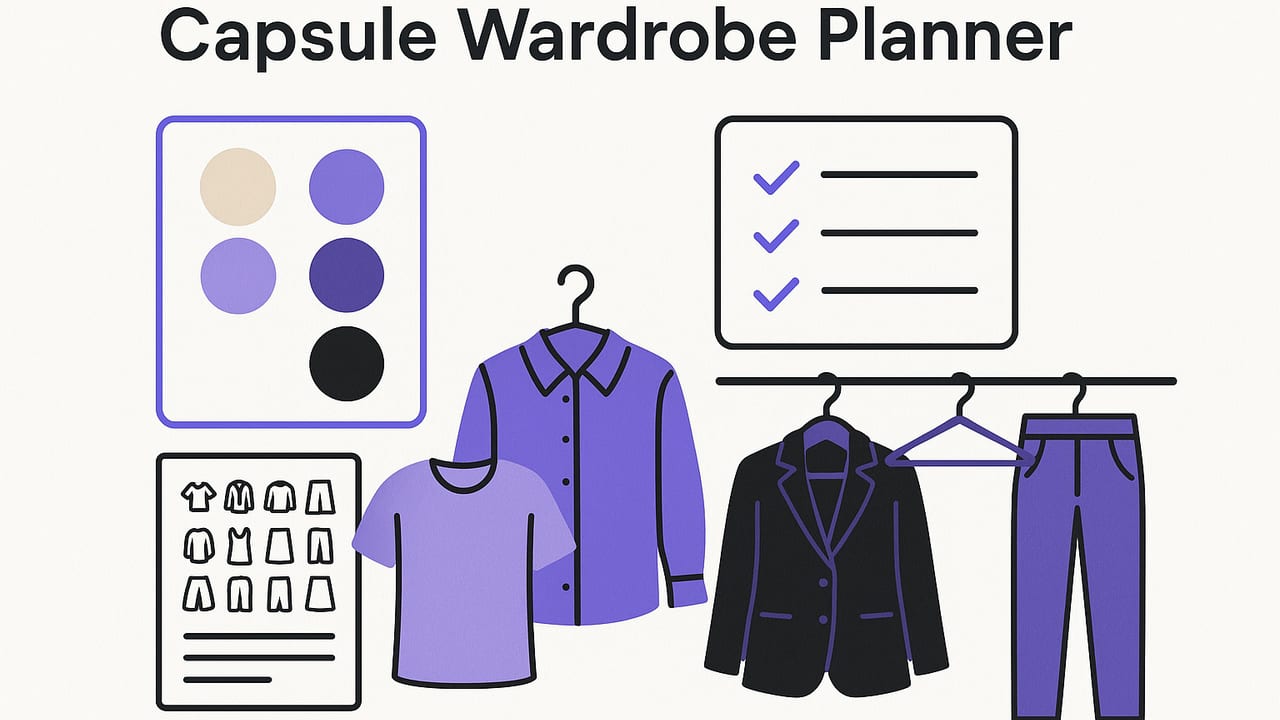
A capsule wardrobe planner is more than a list of minimalist essentials. It’s a simple, repeatable system for selecting fewer pieces that create more outfits, fit your lifestyle, and simplify getting dressed. If you’ve ever stood in front of a full closet thinking you have nothing to wear, a well-structured planner replaces guesswork with clear rules, easy decisions, and consistently wearable combinations.
Below, you’ll find a practical framework to build and maintain your capsule, complete with color palette advice, outfit formulas, universal templates, and lightweight analytics to ensure every item earns its place. Use it as a one-time reset or as an ongoing planner you revisit each season.
What Is a Capsule Wardrobe Planner?
A capsule wardrobe planner is a set of decisions and tools that guide what you keep, buy, and wear. It combines:
- Inventory: A record of your items with photos, categories, colors, and fit notes.
- Rules: Color palettes, silhouette preferences, and outfit formulas that make mixing simple.
- Schedule: A plan for weekly outfits, seasonal swaps, and maintenance.
- Metrics: Wear counts, cost-per-wear, and retirement criteria to keep quality high and clutter low.
Think of it as your personal style operating system: minimal inputs, maximum output.
Why Plan a Capsule Wardrobe?
- Save time: Pre-vetted pieces and ready-made outfits reduce decision fatigue.
- Wear more of what you own: Track wear rates and retire low performers.
- Shop smarter: Fill strategic gaps instead of impulse buying duplicates.
- Travel lighter: A capsule scales down effortlessly for trips.
- Feel consistent: Cohesive colors and silhouettes improve fit and confidence.
“Your capsule isn’t a uniform; it’s a constraint that sparks creativity.”
A Step-by-Step Capsule Wardrobe Planner
1) Map Your Lifestyle and Context
Before colors and counts, plan for reality. List your “life buckets” and rough percentages: work, casual, dressy, active, and special events. Add climate and dress codes. For example: 50% smart casual office, 30% weekend casual, 10% business formal, 10% gym. This ratio should drive your item mix.
2) Choose a Flexible Color Palette
- Core neutrals (2–3): Black, navy, charcoal, tan, ivory, olive. Pick one dark and one light neutral to anchor outfits.
- Secondary neutrals (1–2): Denim, grey, camel, chocolate, stone.
- Accent colors (1–3): 1–2 signature colors plus one seasonal pop. Keep undertones consistent (cool/warm).
Pro tip: If tops and third layers share the same neutral family, you can rotate accents in accessories and footwear for variety without breaking cohesion.
3) Define Silhouettes and Fit Rules
Write 2–3 silhouettes you love and repeat them. Examples:
- Relaxed top + tapered bottom + structured third layer
- Fitted knit + wide-leg trouser + belt
- Midi dress + cropped jacket + ankle boot
Then set a few non-negotiables: inseam ranges, rise height, sleeve lengths, heel maximum, bag scale. These guardrails prevent near-miss purchases.
4) Pick Outfit Formulas
Formulas translate your silhouettes into daily choices. Common patterns:
- 2-piece: Top + Bottom
- 3-piece: Top + Bottom + Layer
- Dress set: Dress + Layer
- Smart casual: Knit + Trouser + Blazer + Loafer
- Weekend: Tee + Denim + Overshirt + Sneaker
Choose 2–4 formulas that cover 80% of your week. Your capsule pieces must fit these formulas with minimal friction.
5) Set Capsule Size and Category Counts
Start with a 25–35 item seasonal capsule (clothes only) plus accessories and shoes. Calibrate by climate and laundry cadence. Here’s an example blueprint:
| Category | Count | Notes |
|---|---|---|
| Tops | 8 | 4 smart casual, 3 casual, 1 dressy |
| Bottoms | 6 | 2 denim, 2 trousers, 1 skirt, 1 tailored short |
| Layers | 4 | 1 blazer, 1 cardigan, 1 overshirt, 1 coat/light jacket |
| Dresses/Jumpsuits | 3 | 1 knit, 1 shirt dress, 1 event-ready |
| Shoes | 5 | 1 sneaker, 1 loafer, 1 boot, 1 heel, 1 sandal |
| Bags | 3 | 1 everyday, 1 work tote, 1 small crossbody |
| Accessories | 3–5 | Belts, scarf, watch, star jewelry piece(s) |
Adjust the ratios to your lifestyle buckets and climate.
6) Audit Your Closet and Score Each Item
Pull items into three piles: Keep, Maybe, Release. Score the “Keep” group with simple criteria:
- Fit and comfort: 0–2
- Color harmony: 0–2
- Condition and care: 0–2
- Versatility (formulas it fits): 0–2
- Frequency worn: 0–2
Items scoring 8–10 make your capsule foundation. 6–7 fill seasonal or accent roles. Under 6 moves to Maybe or Release.
7) Identify Gaps and Create a Targeted List
Compare your capsule goals to your Keep list. Are you missing a dark neutral blazer, a weatherproof boot, or a belt to finish silhouettes? List gaps with exact specs: color, fabric, rise, inseam, heel height, budget, and must-fit formulas.
8) Stress-Test with Outfit Simulations
Before committing, assemble 10–15 outfits that cover a typical two-week cycle. Validate that each bottom works with 3–4 tops and at least one layer. If something bottlenecks (only pairs with one piece), revise the palette or swap the item.
9) Plan Your Week and Track Wears
Plan 5 core outfits for the week using your formulas. Leave one wildcard for weather or mood. Record wears to identify MVPs and dust collectors. After a month, refine counts and retire duplicates.
Capsule Wardrobe Planner Templates You Can Copy
Template 1: Inventory Fields
- Item name, Category, Subcategory
- Color (neutral/accent), Undertone (warm/cool), Pattern
- Silhouette notes (fit, rise, inseam, length)
- Seasonality, Dress code, Climate
- Fabric, Care, Condition
- Price, Wear count, Cost per wear
- Outfit formulas it supports
- Photo link
Template 2: Quick-Start CSV (import into Sheets/Notion)
Item,Category,Color,Undertone,Season,DressCode,Formulas,FitNotes
Navy blazer,Layer,Navy,Cool,All,Smart casual,"Knit+Trouser+Blazer","Structured shoulder"
White tee,Top,White,Cool,Warm,Casual,"Tee+Denim+Overshirt","Relaxed fit"
Wide-leg trouser,Bottom,Charcoal,Cool,All,Smart,"Knit+Trouser+Blazer","High-rise, 30in inseam"
Black ankle boot,Shoe,Black,Neutral,Cool,All,"Any 3-piece","2in heel"
Template 3: Outfit Matrix
Create a 3x3 grid with your top three bottoms on one axis and top three layers on the other. Fill each cell with 1–2 tops that work with that combo. If a cell is hard to fill, that’s a hint to adjust colors or fabrics.
Template 4: 10x10 Test Capsule
Pick 10 pieces (7 garments + 3 shoes) and wear only those for 10 days. Document outfits and friction points. Use your notes to finalize your seasonal capsule.
Digital Capsule Wardrobe Planner vs Spreadsheet
| Approach | Pros | Cons | Best for |
|---|---|---|---|
| Paper or Bullet Journal | Tangible, creative, distraction-free | Hard to search, no photos, manual updates | Visual thinkers, small capsules |
| Spreadsheet/Notion | Custom fields, filters, basic analytics | Time-consuming photos, limited outfit previews | Data-driven planners, DIYers |
| Digital wardrobe app | Photos, tagging, smart suggestions, outfit logs | Learning curve, device dependency | People who want fast visuals and tracking |
Maintain and Measure: Capsule KPIs
Lightweight analytics keep your capsule honest and adaptable.
| Metric | Formula | Target/Insight |
|---|---|---|
| Wear rate | Wears per month per item | Core pieces 2–4x/month |
| Cost per wear | Price ÷ total wears | Trending down over time |
| Mix index | Unique outfits ÷ items used | Higher = versatile capsule |
| Deadweight | % items not worn in 60 days | < 10% for seasonal capsules |
Use these signals to refine counts, swap colors, or schedule alterations. If a piece never hits the formulas, it’s a mismatch, not a personal failure.
Common Capsule Planner Pitfalls (and Fixes)
- Too many accents: Limit to one or two signatures. Let neutrals do the heavy lifting.
- Inconsistent undertones: Mix warm and cool carefully. Choose metals and leathers that harmonize.
- Ignoring footwear: Shoes can bottleneck combinations. Ensure each bottom has at least two shoe options.
- Copying someone else’s capsule: Borrow structure, not items. Your climate, coloring, and dress code are unique.
- Skipping fit specifics: Log inseams, rises, and heel heights to avoid repeat mistakes.
Travel and Special-Event Capsules
For travel, choose one dark neutral and one light neutral, then one accent. Build 8–12 garments around two formulas. Add a dress or sharp blazer to upgrade evenings. For weddings or interviews, create a micro-capsule: one hero outfit plus two swap pieces (alternate shoe and top/layer) to re-wear components the next day.
Weekly Planner Workflow
- Check forecast and calendar: Identify dress codes and temperature swings.
- Choose 2–3 formulas: Assign to key days.
- Pull outfits: Build five outfits from your capsule; hang them together or snapshot them.
- Log wears: Note comfort, compliments, and friction points.
- Sunday review: Swap one item that underperformed and note any emerging gap.
Advanced Tips for a High-Performance Capsule
- Texture triangles: Combine smooth (silk), napped (suede), and structured (denim) for depth without color overload.
- Third-piece rule: If an outfit feels flat, add a layer or accessory that links two colors together.
- Laundry cadence: Increase tops or tees if your wash cycle is long; keep bottoms and layers tighter.
- Seasonal swap box: Store off-season items out of sight to reduce decision fatigue, but keep one off-season wildcard for surprise weather.
- Alterations queue: Many “almost” pieces become MVPs after tailoring. Track status and try-ons.
Putting It All Together
Your capsule wardrobe planner works when it is specific, visual, and measurable. Start with your lifestyle ratios, lock in a cohesive palette, choose a few reliable formulas, and right-size category counts. Audit what you own, fill gaps with precision, and pressure-test outfits before the week begins. Then keep light metrics so the capsule stays lean, useful, and genuinely you.
If you prefer to manage capsules digitally with photos, tagging, and realistic outfit previews, an iOS app like Outfit Maker can help you simulate combinations and track wears alongside your planner.