A capsule wardrobe creator is more than a shopping list—it’s a repeatable system for choosing fewer, better pieces that pair seamlessly and serve your real life. Whether you’re streamlining a bursting closet or building a focused collection from scratch, the right approach can cut decision fatigue, sharpen your style, and save time and money. This guide walks you through a practical, evidence‑based method, from color palettes and outfit formulas to digital organization and maintenance routines. You’ll find templates, examples, and a lightweight data structure so you can treat your wardrobe like a well‑designed product.
What Is a Capsule Wardrobe Creator?
A capsule wardrobe creator is a framework that helps you select a limited set of garments that mix and match broadly across your week or a specific use case (work, travel, postpartum, climate shift). Instead of guessing, you define constraints—palette, silhouettes, quantity ranges, and outfit formulas—then choose pieces that satisfy those constraints.
- Purpose: Reduce decisions, amplify versatility, and align purchases with your lifestyle.
- Scope: Seasonal (8–20 pieces), lifestyle‑specific (work, gym, travel), or all‑year core (timeless base that supports seasonal accents).
- Outcome: A curated set where 80–90% of pieces pair with one another, producing a high outfit yield per item.
“Style is the art of eliminating the unnecessary.”
Think of your capsule as a compact toolkit: each item has a job, interfaces smoothly with others, and earns its keep through frequent, enjoyable wear.
Step‑by‑Step: Build Your Capsule With Intention
1) Define roles, climate, and constraints
List the real contexts you dress for: office, client calls, school drop‑off, gym, weekend, events. Note climate and care constraints (rain, heat, strict dress code, no dry cleaning). This prevents you from building a beautiful but unwearable capsule.
2) Choose a palette that does the work for you
Pick 2 neutrals (e.g., navy + camel), 1 dark base (e.g., black or espresso), and 1–2 accents (e.g., olive, rust). Keep prints to 10–20% of tops or layers. Limiting hues increases pairing probability and reduces clashing.
3) Lock in silhouettes and fit rules
Identify your comfortable base: relaxed trousers + fitted top; straight jeans + fluid blouse; cropped jacket over long column; midi skirt with ankle boots. Write 2–3 “fit laws,” like “tops shorter than high‑rise waistband,” or “one oversized piece maximum per outfit.”
4) Select anchor pieces first
Start with high‑leverage items: a blazer, straight‑leg denim, neutral trouser, versatile knit, and two shoe styles that work with most hems. Add tops last; they are easiest to replace and least impactful on silhouette.
5) Set quantity ranges to avoid over/underbuilding
For a two‑week work capsule: 3–4 bottoms, 5–7 tops, 2–3 layers, 2–3 shoes, and 2 belts/scarves. For travel carry‑on: 2 bottoms, 4 tops, 1–2 layers, 2 shoes. These bands keep the capsule nimble without feeling sparse.
6) Test mix‑and‑match before committing
Lay everything out. Pair each bottom with each top and at least one layer. Replace any piece that fails to make 3+ outfits. Photograph combinations for quick recall and iterate before buying gaps.
Outfit Formulas That Multiply Your Options
Use simple, reusable formulas to ensure cohesion and variety:
- Three‑Piece Rule: Outfit = Base (top + bottom) + Third Layer (blazer, cardigan, overshirt). The third piece adds structure and polish.
- Texture Triad: Combine smooth + knit + leather/suede for depth. Example: crisp poplin shirt, fine‑gauge knit, suede loafer.
- Proportion Balancing: Voluminous top + slim bottom; slim top + wide leg; long layer over fitted base.
- Color Ratio: 2 neutrals + 1 accent per outfit; prints count as accent.
Quick math for outfit potential: If you have 4 tops × 3 bottoms × 2 layers with 80% cross‑compatibility, your base yield is roughly 4 × 3 × 2 × 0.8 = 19 looks, not counting shoes and accessories. Shoe swaps often double the perceived variety.
Capsule Templates by Lifestyle
| Lifestyle | Piece Count | Example Formula | Notes |
|---|---|---|---|
| Hybrid Work | 12–16 | 4 tops, 3 bottoms, 3 layers, 2 dresses, 2 shoes | Mix knit blazers and refined denim if policy allows. |
| Carry‑On Travel (7–10 days) | 10–12 | 4 tops, 2 bottoms, 2 layers, 1 dress, 2 shoes, 1 accessory kit | Choose wrinkle‑resistant fabrics; coordinate all to one shoe color. |
| Creative Casual | 10–14 | 5 tops, 3 bottoms, 2 layers, 2 shoes, 1 wild card | Use one print and one bold accent; keep silhouettes consistent. |
| Warm‑Climate Minimal | 8–10 | 4 tops, 2 bottoms, 1 light layer, 1 dress, 2 shoes | Breathable fabrics; hats and sunglasses do heavy lifting. |
| Postpartum/Changing Size | 10–12 | 5 tops, 3 flexible bottoms, 2 layers, 2 shoes | Elastic waists, wrap fronts, machine‑washable knits. |
Digital Workflow: Turn Your Closet Into Data
A strong capsule wardrobe creator benefits from light structure. Photograph items on a clean background in indirect light. Add metadata so you can filter quickly by color, category, season, and use.
- Tag taxonomy: category (top/bottom/layer/dress), color, season, formality, fabric, care, heel height.
- Naming convention: Brand_Model_Color_Fit (e.g., “Everlane_90sStraight_Black_27”).
- Metadata to track: cost, acquisition date, wears, last worn, notes on fit or alterations.
Here’s a compact JSON schema you can adapt to a spreadsheet or notes app:
{
  "item_id": "T-001",
  "category": "top",
  "name": "Poplin Shirt",
  "color": "white",
  "palette_group": "neutral",
  "season": ["spring", "summer"],
  "formality": "smart-casual",
  "fabric": "cotton",
  "care": "machine-wash",
  "fit_notes": "relaxed; tuck-friendly",
  "cost": 68,
  "acquired": "2024-09-15",
  "wears": 18,
  "last_worn": "2025-05-10",
  "pairs_well_with": ["B-002", "L-003", "S-001"],
  "status": "active"
}
Use filters to simulate new capsules without pulling everything out physically. Sort by “pairs_well_with” to expose high‑leverage items and to spot gaps.
Maintenance and Analytics: Keep the Capsule Working
- 30‑Wear Review: After ~30 wears, reassess fit and condition. Repair, resole, or retire.
- Cost‑Per‑Wear (CPW): CPW = cost / wears. Aim to lower CPW on anchors; donate or sell pieces with persistently high CPW.
- One‑In, One‑Out: When you add a new item, exit a redundant one to preserve clarity.
- Laundry Rhythm: Align quantity with laundry frequency. If you wash weekly, 5–7 tops is plenty for workdays.
- Seasonal Swap: Box off‑season items and label with palette and purpose to reduce visual noise.
Common Pitfalls and How to Fix Them
- Palette too tight: Everything matches but feels flat. Add one accent or texture (suede, rib knit) to reintroduce depth.
- Ignoring shoes: Hem lengths and shoe shapes must harmonize. Fit bottoms to your most‑worn shoe height first.
- Trend overload: Keep trends as the 10–20% “wild card” so your base remains wearable next season.
- Climate mismatch: Choose fabrics for your weather reality (e.g., tropical wool for humidity, tech twill for rain).
- Over‑complicating tags: Start with 5–7 core tags; add more only if they drive a decision.
Example Build: 12‑Piece Late‑Spring Work Capsule
Palette: navy, stone, white, black, olive. Silhouettes: straight‑leg trousers, straight jeans, column dress, cropped jacket.
- Bottoms (3): navy straight trouser, stone wide‑leg trouser, black straight jean.
- Tops (5): white poplin shirt, black ribbed tee, navy silk shell, olive knit polo, striped breton.
- Layers (2): navy blazer, light camel cardigan.
- Dresses (1): black midi column.
- Shoes (1 core pair assumed): black leather loafer (add a low heel or white sneaker as optional item 13).
Outfit yield estimate: 5 tops × 3 bottoms × 2 layers ≈ 30 looks at 80% compatibility = ~24 looks, plus 3–4 dress‑based looks with layers. With a loafer and one alternate shoe, perceived variety climbs further.
Weekly rotation sample:
- Mon: navy trouser + silk shell + blazer + loafer
- Tue: stone wide‑leg + breton + camel cardigan
- Wed: black jeans + poplin shirt + blazer
- Thu: column dress + camel cardigan
- Fri: black jeans + ribbed tee + blazer
Every look follows the Three‑Piece Rule and respects palette and proportion for easy consistency.
Advanced: Audit With an Outfit Grid
When refining your capsule, visualize combinations as a grid to spot dead ends:
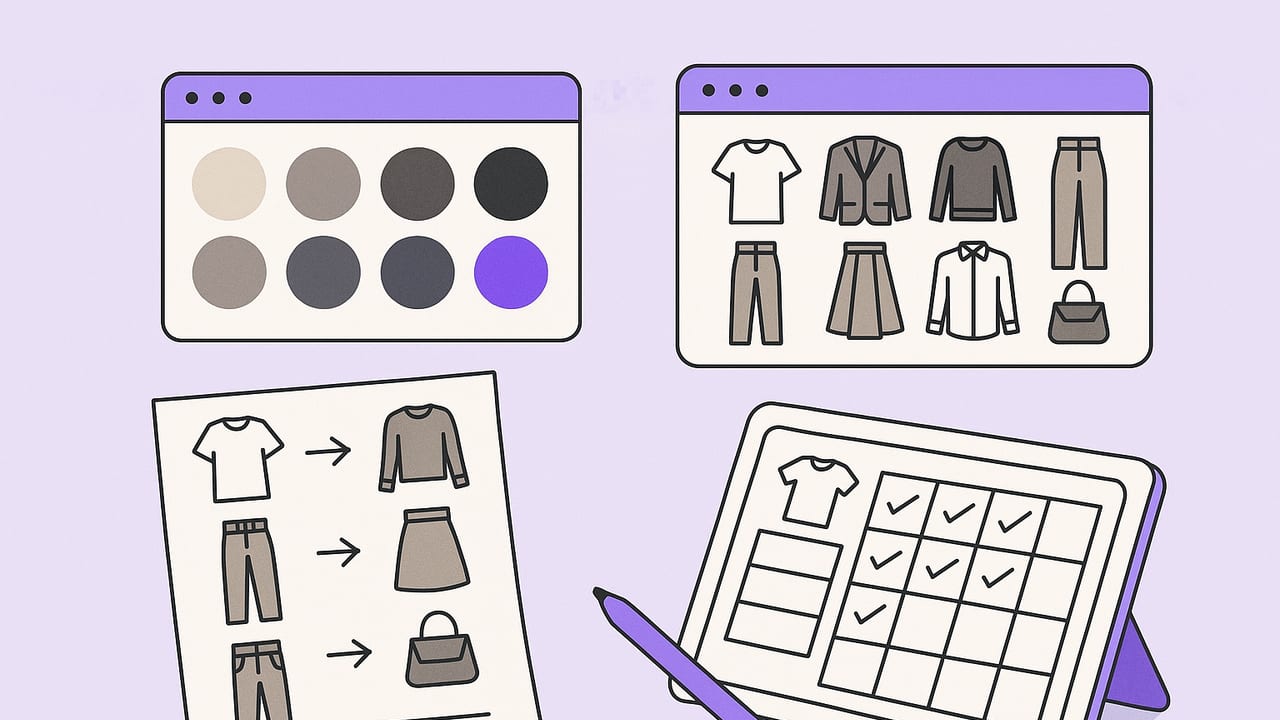
- Rows = bottoms, columns = tops, cells = viable outfits. Add a dot for layer compatibility.
- Any top or bottom with fewer than 3 marked cells is a candidate for alteration, replacement, or removal.
- Target 80–90% cell fill for a tightly integrated capsule.
Quick‑Start Checklist
- List your top 3 weekly roles and one climate constraint.
- Pick 2 neutrals + 1 dark base + 1 accent.
- Write 2 fit rules you’ll follow.
- Choose anchors: 1 blazer, 2–3 bottoms, 1 core shoe.
- Add 4–6 tops that obey your palette and fit rules.
- Photograph and tag items; remove pieces that don’t make 3+ outfits.
- Track wears for 30 days; adjust based on real data, not wishful thinking.
FAQs: Capsule Wardrobe Creator
How many pieces should a capsule include? Enough to cover your week without laundering pressure. For most, 10–16 per capsule works. If you do laundry bi‑weekly, add 1–2 tops.
Do I need to replace everything? No. Start with what you have, define gaps, and upgrade high‑leverage items first (layers, bottoms, shoes).
What about prints? Limit to one hero print or keep prints within one category (e.g., only striped tops) to maintain cohesion.
Can a capsule be colorful? Absolutely. Keep the structure; choose a tight palette of harmonizing colors and repeat shades across categories.
Bringing It All Together
A capsule wardrobe creator works because it imposes friendly constraints that free you to focus on what matters: fit, feel, and function. Define roles and palette, set quantities, lock in silhouettes, then validate with quick mix‑and‑match tests and light data tracking. The result is a closet that plans itself—clear, versatile, and aligned with your life. If you want to experiment digitally with photos, tags, and virtual try‑on to preview combinations before changing clothes, consider a dedicated iOS wardrobe planner such as Outfit Maker.